
Reviewed · 3-HOUR EXPERIENCES
Brussels 3-Hour Guided Art Nouveau Tour
Brussels reveals its secrets in iron and glass. This three-hour walking tour takes you from the Grand-Place to the Bailli district, where Victor Horta and other Belgian architects reshaped city homes with curling metalwork, flowing lines, and clever combinations of stone, wood, and glass. I like that the route reaches streets most first-time visitors skip, and I also like the way the guide connects buildings to politics, technology, and daily life. The main catch is simple: you see the buildings from the outside, and museum admission is not included.
At $35 per person, this is a fair deal if you want structure and explanation rather than a self-guided hunt for addresses. You should expect plenty of walking, an uphill start, and a tram ride with transport costs not included. The tour ends at the Victor Horta Museum, which makes it easy to continue the architectural lesson on your own, provided you reserve a museum ticket in advance.
In This Review
- Key points at a glance
- Why Brussels is the right place for Art Nouveau
- Meeting at the Grand-Place and reaching Bailli
- Old England House and the first lesson in metalwork
- Hotel Tassel, Horta’s breakthrough residence
- Van Rysselberghe House and the private side of the movement
- Hotel Otlet and the partnership behind it
- Hotel Goblet d’Alviella and an earlier experiment
- Paul Hankar’s bold residential designs
- The Beukman House and Albert Roosenboom
- Finishing at the Victor Horta Museum
- The guide makes or breaks the experience
- What the $35 price really buys you
- Who should book this walk?
- Should you book the Brussels Art Nouveau Tour?
- FAQ
- Where does the Art Nouveau tour meet?
- What time does the tour start?
- How long does the tour last?
- Which languages are available?
- Is transportation included?
- Does the tour include Victor Horta Museum admission?
- Can I enter the Art Nouveau houses?
- Is the tour wheelchair accessible?
Key points at a glance
- A focused route beyond central Brussels: The tour leaves the Grand-Place and heads to Bailli, an area with one of the city’s largest collections of Art Nouveau buildings.
- Horta is only part of the story: You see work by Victor Horta, Paul Hankar, Octave Van Rysselberghe, Henry van de Velde, Albert Roosenboom, and others.
- Exterior viewing only: Interior photographs and printed images help explain what you cannot enter, but no private homes are opened during the tour.
- Strong historical context: The guide explains how new materials and social changes shaped the movement, not just how the façades look.
- A useful museum finish: The route ends at the Victor Horta Museum, but admission must be booked and paid for separately.
- Three languages are offered: Tours are available in English, French, and Spanish, sometimes requiring bilingual explanations.
Why Brussels is the right place for Art Nouveau
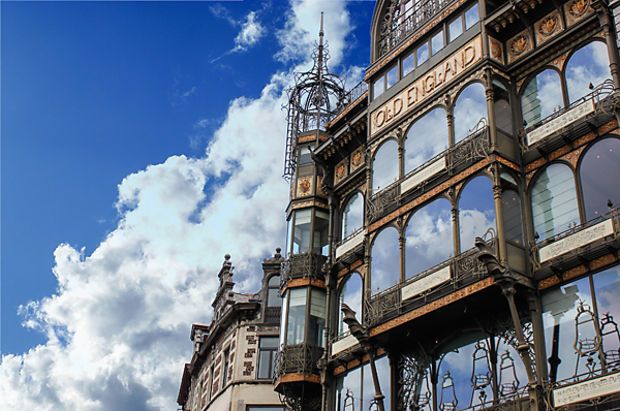
Brussels is one of the best cities for seeing Art Nouveau in its original setting. The style developed here in the late 19th century, when architects began pushing back against stiff historical designs and experimenting with modern materials and natural forms.
The buildings on this route show that Art Nouveau was not simply decoration pasted onto old houses. Iron could become a railing, a support, or a curling plant-like line. Glass brought daylight into stairwells. Woodwork, stone, tile, and metal were designed as one visual system.
I find this important because the façades can seem pretty but random when you first see them. A good guide gives you a way to read the details. You begin to notice how a doorway, window frame, balcony, and interior stairwell were meant to work together.
The tour also places architecture in its social setting. Brussels was changing quickly, and wealthy clients wanted houses that expressed modern taste, status, and individuality. The movement also connected with political and cultural ideas of the period. Guide Maria, in particular, has been praised for explaining those links and for sharing theories from her own research.
A few more trips and experiences worth a look
- Brussels: Private 3-Hour Sightseeing Walking Tour
★ 4.6 · 112 reviews - Beer Tasting and Scavenger Hunt in Brussels – About 3 Hours
★ 4.5 · 35 reviews - Private Wellness (3 hours)
★ 5.0 · 6 reviews
Meeting at the Grand-Place and reaching Bailli
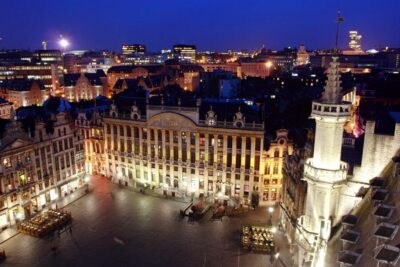
The meeting point is the Grand-Place, Brussels’ grand central square. Look for the guide holding a white umbrella. The tour starts at 10:00, though you should check the selected date for the exact available starting time.
The first section includes a tram ride to the Bailli district. Transportation is not included in the tour price, so bring the means to cover that ride. The tram is not just a practical transfer. It moves you from the highly polished center into a residential part of Brussels where Art Nouveau appears in a more local setting.
Bailli is described as a famous village within the city, and that is a useful way to understand the area. You are not simply ticking off famous monuments. You are walking through ordinary streets where ambitious private homes sit alongside later buildings and everyday city life.
The route involves walking and some uphill movement, especially near the beginning. Comfortable shoes are essential. The tour is wheelchair accessible, but the walking distance, tram segment, and incline are still worth considering when deciding if the pace suits you.
Old England House and the first lesson in metalwork
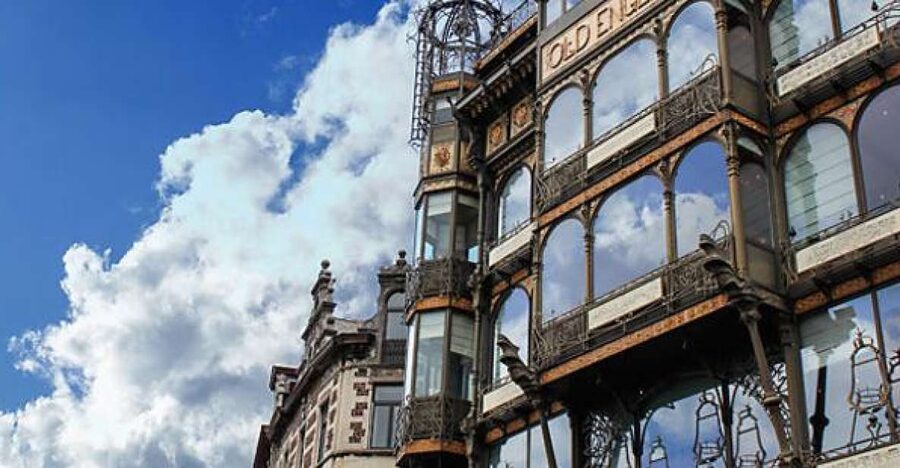
Old England House, now associated with the Musical Instrument Museum, provides an early look at Brussels’ love of expressive metal and glass. Its elaborate exterior signals the shift away from plain, formal façades.
This stop works well as an introduction because it helps you understand the materials before the route turns toward private residences. Art Nouveau architects did not treat iron as something that had to be hidden. They made it part of the design.
You may not spend a long time here, and the tour does not include admission to the Musical Instrument Museum. Still, the building helps set the tone. It shows how a commercial or public structure could use the new style to attract attention from the street.
Hotel Tassel, Horta’s breakthrough residence
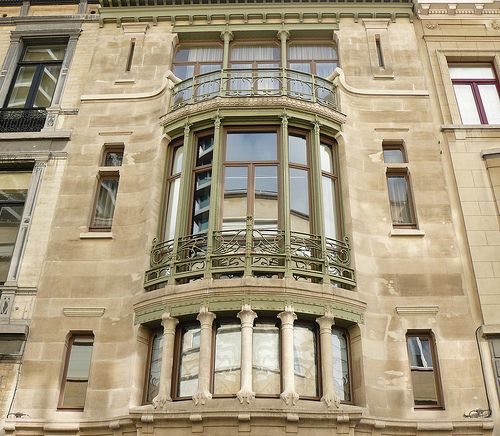
Hotel Tassel is one of the key stops. Victor Horta built it in 1893 and 1894, and it is often treated as a major early work in Brussels Art Nouveau.
The name can be confusing because this is a private townhouse, not a conventional hotel for overnight stays. Its importance comes from the way Horta designed the whole building as a unified work, rather than adding a few fashionable details to a standard house.
From the street, you can study the curves, openings, stonework, and iron details. The real power of the design is easier to understand when you see interior images, since the famous stairway and decorative planning cannot be experienced from the pavement.
That limitation affects the whole tour. You are looking at façades, not entering the residences. Guides often bring printed photographs or images to show the interiors. Maria has been praised for using interior pictures to make the outside views more meaningful.
Something different, still within reach of Brussels:
- Brussels: Atomium Entry Ticket with Design Museum Ticket
★ 4.4 · 9,254 reviews - From Brussels: Guided Day Trip to Bruges and Ghent
★ 4.6 · 8,353 reviews - From Brussels: Bruges & Ghent Day Tour – 2 Fairytale Cities
★ 4.7 · 8,242 reviews - Choco-Story Brussels: Chocolate Museum Entrance with Tasting
★ 4.3 · 4,883 reviews
Van Rysselberghe House and the private side of the movement
The Van Rysselberghe House was built by Octave Van Rysselberghe in 1912. By this point, Art Nouveau had developed beyond its earliest experiments, and the house helps show how the style continued into the next phase of Brussels architecture.
Octave Van Rysselberghe appears several times on the itinerary, which gives you a chance to compare his work with Horta’s and Paul Hankar’s. That comparison is one of the tour’s strengths. You are not left with the idea that every Art Nouveau building follows one formula.
Because these are private homes, the experience depends on the guide’s explanation. Look closely at the proportions, windows, entryways, and decorative patterns while the group discusses the architect and client. Without that context, some façades may appear more restrained than expected.
Hotel Otlet and the partnership behind it
Hotel Otlet was created by Octave Van Rysselberghe and Henry van de Velde between 1894 and 1898. It is a useful stop for understanding that Art Nouveau was not the work of one famous architect alone.
Van de Velde is associated with the broader development of modern design, and this building lets the guide discuss collaboration and changing ideas about architecture. The emphasis is on how structure and decoration were combined, rather than treating them as separate jobs.
You may find that the route slows here as the guide points out details from the pavement. That can be rewarding if you enjoy close looking, but the amount of information may feel heavy if you mainly want a quick photo walk.
Hotel Goblet d’Alviella and an earlier experiment
Hotel Goblet d’Alviella, built by Octave Van Rysselberghe in 1882, gives the itinerary an earlier date than many of the better-known Art Nouveau works. It helps show that architectural change happens gradually.
The building is especially useful in comparison with the later houses. You can ask the guide to point out what feels more traditional and what suggests a new direction. The movement was not born fully formed. Architects tested ideas, adjusted them, and responded to different clients.
This stop also reminds you that a three-hour route cannot cover every important Art Nouveau address in Brussels. The city has more surviving examples than this tour can include. If you want a fuller survey, ask the guide for additional addresses or use the Art Nouveau material available at the Horta Museum.
Paul Hankar’s bold residential designs
Paul Hankar appears repeatedly in the next part of the route. His Hotel Ciamberlani, built in 1897, and the house of painter René Janssens, built in 1898, show a different approach from Horta’s work.
The Hotel Ciamberlani is notable for its curved lines and strong façade design. The house built for René Janssens connects architecture with the artistic world, since the client was a painter. These homes help you see how Art Nouveau appealed to people who wanted their residences to reflect creative identity.
The tour also passes the private home of Paul Hankar. That detail gives the architect’s work a personal angle. You are not only seeing buildings made for clients, but also considering how an architect shaped his own living environment.
The route includes architect Armand Van Waesberghe as well. This broader selection is valuable because it prevents the tour from becoming a single-architect biography. Horta is the headline name, but Brussels’ Art Nouveau story is much wider.
The Beukman House and Albert Roosenboom
The Beukman House, designed by Albert Roosenboom in 1900, adds another voice to the group of architects. By this point in the walk, you should have enough examples to compare the designers rather than simply admire each house in isolation.
This is where the guide’s teaching matters most. A strong explanation can point out recurring ideas, such as organic curves, asymmetry, exposed metal, and the deliberate relationship between a front door and the rooms behind it.
The tour is also a lesson in looking. At the start, you may notice only the broad shape of a building. Later, you are more likely to inspect a balcony support, a window surround, or a transition between stone and iron. Several people have found that the route makes them notice Art Nouveau details elsewhere in Brussels after the tour ends.
Finishing at the Victor Horta Museum
The tour ends in front of the Victor Horta Museum, located in Horta’s former home and studio. This is a smart place to finish because the outdoor tour gives you a framework for understanding the interiors.
Admission is not included. I strongly recommend reserving a separate museum ticket ahead of time if you want to go inside immediately after the walk. The museum may be the most satisfying follow-up because you can finally see the staircases, rooms, furniture, and decorative elements that the guide could show only through photographs during the route.
Do not assume that ending at the museum guarantees entry. One participant missed the interior visit because a ticket had not been reserved. Treat the museum as an optional second activity, not as part of the $35 tour.
The guide makes or breaks the experience
The strongest part of this tour is the guide’s subject knowledge and enthusiasm. Maria has led tours that connect architecture with social and political life, while Danielle has also been described as highly enthusiastic about Brussels’ Art Nouveau buildings. Depending on the date, you may have a different guide.
The tour is available in English, French, and Spanish. On bilingual outings, the guide may repeat the full explanation in two languages. That can make the tour run longer and may feel less brisk, but it also allows a mixed group to follow along.
A few practical points help. Stay close enough to hear when the group gathers on a narrow pavement. Ask questions when the guide pauses, especially if you want extra building addresses. The information can be detailed, and the walk is more rewarding when you participate instead of treating it as a series of photo stops.
The experience has received an overall rating of 4 out of 5 from 282 bookings. The most praised features are the guide’s preparation, clear explanations, passion for the subject, and ability to show parts of Brussels that a standard city tour often skips.
What the $35 price really buys you
At $35, you are paying for a three-hour route, a local guide, historical interpretation, and access to a carefully chosen set of façades. You are not paying for museum entry, private-house access, or the tram ride.
That is reasonable value if Art Nouveau is a real interest. Finding the buildings on your own is possible, but you would need addresses, a route map, and enough background to understand what you are seeing. The tour saves that preparation time and adds explanations that a guidebook may not provide on the spot.
The value is weaker if you expect grand interiors or a long list of famous monuments. The route covers only one part of Brussels, and several buildings can be viewed only from public streets. It is best thought of as an informed neighborhood walk, not a museum tour.
Who should book this walk?
I would recommend it to anyone interested in architecture, design, urban history, or Victor Horta. It also suits repeat visitors who have already seen the Grand-Place and want a more specialized look at Brussels.
You will get the most from it if you enjoy walking, examining façades, and listening to detailed explanations. It is less suitable if you want a relaxed ride, dislike uphill streets, or need every stop to include interior access.
Families with older children may enjoy the material-and-design angle, especially the way iron, glass, wood, and stone are used. The tour is wheelchair accessible, but the distance and incline should still be considered before booking.
Free cancellation up to 24 hours before the activity and reserve-now, pay-later booking make it easier to fit the walk into a changing Brussels schedule. Bring comfortable shoes, and allow extra time afterward if you have booked the Horta Museum.
Should you book the Brussels Art Nouveau Tour?
Book it if you want to understand how Brussels became one of Art Nouveau’s great cities, not merely photograph a few ornate houses. The guide-led comparisons between Horta, Hankar, Van Rysselberghe, van de Velde, and other architects give the route real purpose.
Skip it if you require interior visits or prefer exploring at your own pace. For most architecture-minded visitors, though, $35 is a sensible price for three hours of focused sightseeing, especially when you pair it with a pre-booked visit to the Victor Horta Museum.
FAQ
Where does the Art Nouveau tour meet?
The meeting point is the Grand-Place in Brussels. The guide will be holding a white umbrella.
What time does the tour start?
The tour is scheduled to start at 10:00. Check availability for the exact starting time on your chosen date.
How long does the tour last?
The guided experience lasts three hours.
Which languages are available?
The tour is offered in English, French, and Spanish.
Is transportation included?
Transportation is not included. The route uses a tram to reach the Bailli district, so you must pay for that transport separately.
Does the tour include Victor Horta Museum admission?
No. The tour ends in front of the Victor Horta Museum, but museum admission is separate.
Can I enter the Art Nouveau houses?
The buildings on the route are viewed from the outside. The guide may use photographs or printed images to explain interiors that you cannot enter.
Is the tour wheelchair accessible?
Yes, the activity is listed as wheelchair accessible. Comfortable shoes are recommended because the route includes substantial walking and an uphill section.
Just added around Brussels
- Discover the secrets of Brussels while playing★ 5.0 · 3 reviews
- Standard vehicle from Charleroi airport to city of Brussels★ 4.5 · 3 reviews
- Full day Brugge & Ghent: the gems of Flanders★ 5.0 · 3 reviews
- Private tour : Best of Brussels half day From Brussels★ 5.0 · 3 reviews
- Private Tour – Bruges and Ghent, our fairytale cities★ 5.0 · 3 reviews
- Floating in the clouds★ 5.0 · 3 reviews
- Full-Day City Tour of Ghent and Bruges from Brussels★ 4.5 · 3 reviews
- Brussels Private Walking Tour With A Professional Guide★ 4.5 · 3 reviews
3-Hour Experiences, compared.


Beer Tasting and Scavenger Hunt in Brussels – About 3 Hours
Read our review →
BRYGGJA ROMANTICA – 3 Hour Romantic Tour in Bruges
Read our review →
Private 3-hour walking tour of Bruges with official tour guide
Read our review →Browse the lists this tour appears in