
Reviewed · E-SCAVENGER HUNTS & CITY GAMES
e-Scavenger hunt Ghent: Explore the city at your own pace
Ghent rewards curious walkers. I like the freedom to explore at your own speed, and the app turns a simple city walk into a family-friendly clue game. The route brings you to major sights such as Ghent Town Hall and Gravensteen, while short tips help add context as you go.
The main tradeoff is the lack of a live guide. You need your own smartphone and mobile data, and some people may find app-based clues less satisfying than a detailed walking tour. Still, the private format is useful if you want to pause for lunch, take photos, or let your group set the pace.
In This Review
- Key points at a glance
- Starting at Sint-Baafsplein, Ghent’s historic core
- Vrijdagmarkt and the city’s old public life
- Town Hall and the layers of Ghent’s government
- Saint Bavo’s Cathedral and Ghent’s famous tower row
- The Devil’s Stone and a glimpse of medieval power
- Gravensteen, Ghent’s medieval castle
- Graslei, Korenlei, and the Leie river
- St. Michael’s Bridge and the best city-center view
- Patershol and Ghent’s narrow medieval lanes
- Graffiti Street and Ghent’s modern voice
- The Museum of Fine Arts and a wider cultural view
- What $37.24 means for a group of six
- Who should choose this Ghent city trail?
- Practical details before you set out
- My verdict on this self-guided Ghent experience
- FAQ
- Where does the e-Scavenger hunt in Ghent start?
- Where does the activity end?
- How long does the Ghent scavenger hunt take?
- How many people can join one city trail?
- Is a smartphone included?
- What language is the activity offered in?
- Can I cancel for a full refund?
Key points at a glance
- Start in the heart of Ghent: Begin and finish at Sint-Baafsplein, close to Saint Bavo’s Cathedral and the Belfry.
- Follow a two-to-four-hour route: The walk covers central squares, canals, churches, medieval lanes, and major landmarks.
- Play as a private group: One city trail is designed for up to six people, with no other groups joining you.
- Use your phone as the guide: The free app provides clues and tips, but your smartphone and data are not included.
- See Ghent’s best-known sights: The route includes Gravensteen, Graslei and Korenlei, St. Michael’s Bridge, Patershol, and more.
- Pay one group price: At $37.24 for up to six people, the cost can be good value for a family or small group.
Starting at Sint-Baafsplein, Ghent’s historic core
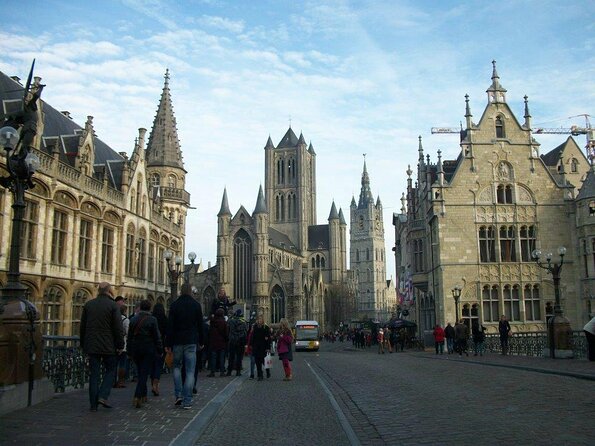
Your starting point is Sint-Baafsplein, 9000 Gent, Belgium. This puts you near three of Ghent’s most recognizable towers: Saint Bavo’s Cathedral, the Belfry, and Saint Nicholas’ Church.
The starting location is practical because the route quickly places you in the old center. You are not spending the first part of the activity walking through ordinary modern streets to reach the sights. The city’s medieval heart is close at hand, with the Korenmarkt and the Leie river forming the main focus.
The activity is self-guided, so you connect to the app with your own phone and work through the clues as you walk. That setup gives you control. You can stop for coffee, linger beside the water, or take a longer look at a church without holding up a guide or another group.
The walk is estimated at two to four hours. The broad range matters. A fast group focused on solving clues may finish closer to two hours, while a family stopping for photos, food, and sightseeing may need much longer. You should treat the timing as flexible rather than a strict schedule.
More E-Scavenger Hunts in Ghent
- Discover Ostend while playing! Escape game – The Walter case
★ 4.0 · 16 reviews - e-Scavenger hunt Kortrijk: Explore the city at your own pace
★ 4.5 · 15 reviews - e-Scavenger hunt Ostend: Explore the city at your own pace
★ 4.5 · 10 reviews
Vrijdagmarkt and the city’s old public life
One early stop is Vrijdagmarkt, one of Ghent’s oldest squares. It covers about one hectare, giving it a spacious feel compared with the narrow streets around it.
The square helps you understand how Ghent worked as a civic and commercial center. It was not built simply as a pretty place for photographs. Its size and position made it useful for public gatherings, trade, and city life.
The app’s clues give you a reason to look carefully instead of walking straight across the square. That is one of the better features of this format. You are not just being led from one postcard view to the next. You are asked to notice details, discuss answers, and keep moving as a group.
For children, Vrijdagmarkt can be a good point to reset. There is room to pause, and the open space breaks up the tighter lanes that come later. If your group includes younger children, the game element may help keep their attention through the more traditional church and architecture stops.
Town Hall and the layers of Ghent’s government
Ghent Town Hall is a large four-sided complex surrounded by the Botermarkt, Hoogpoort, Stadhuissteeg, and Poeljemarkt. It is less like one single building and more like a collection of architectural pieces gathered around a central block.
That makes it a useful stop for an app-based walk. The clues can direct your attention to the way the complex changes from one side to another. You get a better sense of Ghent’s civic power by walking around it rather than seeing only one decorated facade.
The Town Hall is also close to several other points on the route, so this part of the walk should feel efficient. You are moving through a compact historic center rather than crossing the city repeatedly.
I would not plan to spend the full four hours on the clues alone. The appeal is that the route puts you beside important buildings, then leaves you free to decide how much time each deserves. If you want a detailed explanation of every architectural period, you may miss having a human guide here.
Saint Bavo’s Cathedral and Ghent’s famous tower row

Saint Bavo’s Cathedral is the oldest parish church in the lively center of Ghent. The present building sits on the site of a 10th-century church and an earlier Romanesque church, giving this stop several layers of age beneath the later structure.
The cathedral is a strong early highlight because it connects the city’s religious past with its present-day streets. Even if you do not enter, the exterior and setting show how closely church life and civic life were linked in old Ghent.
Nearby, the Belfry rises 95 meters above the center. It is the middle tower in Ghent’s famous three-tower row, with Saint Bavo’s Cathedral and Saint Nicholas’ Church completing the sequence.
The Belfry is one of the route’s essential sights. You should take a moment to look at how the three towers line up through the city center. It is an easy detail to miss when you are focused on the next clue.
Saint Nicholas’ Church was the church of wealthy merchants and Ghent’s guilds. Its history reaches back to the 11th century, and its location near the Korenmarkt made it part of the commercial center as well as the religious one.
The church stops work well together. Instead of treating each building as an isolated attraction, the walk helps you see a cluster of churches, trade, government, and public space within a short distance.
More self-guided city games in Ghent:
- Discover Mons while playing! Escape game – The alchemist
★ 4.0 · 5 reviews - Discover Ghent while playing! Escape game – The Walter case
★ 4.5 · 4 reviews - Discover Ghent while playing! Escape game – The alchemist
★ 4.0 · 4 reviews - e-Scavenger hunt Mons: Explore the city at your own pace
★ 5.0 · 4 reviews
The Devil’s Stone and a glimpse of medieval power

The route also includes a stone building named for its builder, the knight Gheeraert Vilain, who was nicknamed the Devil. The city of Ghent bought it around 1328.
The nickname gives this stop a bit of character, especially for children who may respond more quickly to a story about a knight and a devil than to a date on a plaque. The building also adds a smaller-scale point of interest between the city’s major monuments.
This is where the app’s short tips can be useful. A quick clue or historical note gives you something specific to look for, without requiring you to read a long block of text while standing in the street.
You should keep your expectations in check. This is a city game, not a full architectural lecture. The information is meant to keep the walk lively and help you notice places you might otherwise pass.
Gravensteen, Ghent’s medieval castle
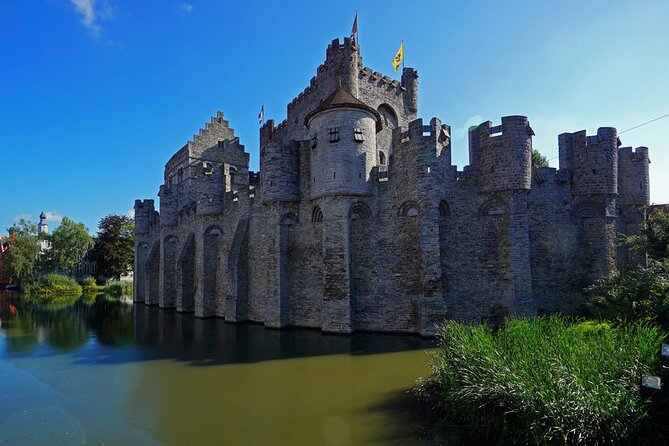
Gravensteen is the route’s most dramatic stop. It is the only remaining medieval castle in Flanders with an almost intact defense system, which makes it unusual even in a city filled with old buildings.
The castle gives the walk a change of mood. After squares, churches, and merchant streets, you reach a place built for defense and authority. Its walls and defensive features make the medieval past feel more physical than it does at a church facade.
The app can introduce the castle as part of the larger route, but admission is not listed among the included features. If you want to go inside, check the separate entry arrangements before booking. The city trail price covers the game and app, not a stated castle ticket.
Even from outside, Gravensteen is worth the stop. You get a clear sense of how unusual it is to find such a well-preserved fortress within a living city center. I would allow extra time here if your group enjoys castles, but remember that this can push the walk toward the four-hour end of the estimate.
Graslei, Korenlei, and the Leie river

The route then brings you to Graslei and Korenlei, two of Ghent’s best-known waterside areas. Historic buildings line the river, while terraces, boats, and the water create one of the city’s most enjoyable places to pause.
This is a good spot to put the phone away for a few minutes. The game gives you a reason to reach the river, but the riverfront itself deserves your attention. Look across the Leie, compare the building fronts, and watch the boats move through the center.
The Korenlei also connects to Ghent’s grain trade. Since the 10th or 11th century, the area has been linked to grain arriving through the Leie or Scheldt. That detail explains why the riverfront was economically important, not merely attractive.
I especially like this part of the route for groups with different interests. One person can study the old buildings, another can enjoy the water, and children can look for boats while the group works out the next clue.
The only concern is that scenic stops can make the advertised timing feel short. If you want a relaxed walk, keep the four-hour estimate in mind and avoid scheduling a tight appointment immediately afterward.
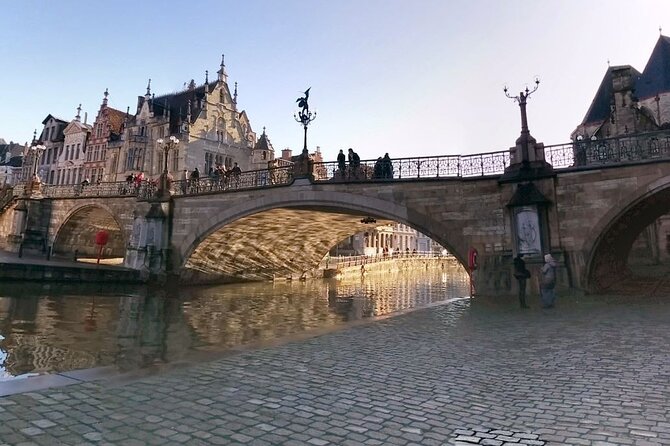
St. Michael’s Bridge and the best city-center view

St. Michael’s Bridge sits beside St. Michael’s Church near the Korenmarkt. It crosses the Leie and faces toward the city center.
This is a natural photo stop, but it is also one of the clearest places to understand Ghent’s layout. From the bridge, you can connect the river, the towers, the old streets, and the waterside buildings in one view.
The route benefits from including places like this between the larger landmarks. A city walk should not be only a checklist of famous buildings. Bridges and public spaces show how the city fits together.
The bridge can also help your group get its bearings. If the app ever feels confusing, the surrounding landmarks give you visible reference points. You are still responsible for following the route on your phone, so keep the device charged and make sure your data connection works before setting out.
Patershol and Ghent’s narrow medieval lanes
Patershol is an old neighborhood in the historic center, with narrow medieval streets and many cafes and restaurants. It offers a different experience from the broad squares and open riverfront.
Here, the pleasure comes from wandering slowly. The lanes are close and irregular, and the neighborhood feels more intimate than the large central spaces. The cafes and restaurants make it a practical place to pause for a meal or drink, though the activity does not include food.
Patershol is also a useful reminder that Ghent’s historic center is not a museum set. People still eat, meet, and move through these streets. You get a more complete sense of the city by passing through an old neighborhood, not only visiting major monuments.
If your group includes anyone with limited patience for clues, this section can help because the streets themselves are interesting. If your group includes a child in a stroller, narrow medieval streets may require more care, though the supplied information says most people can participate.
Graffiti Street and Ghent’s modern voice
The winding alley between Hoogpoort and Donkerstraat is also called Graffiti Street because of its appearance. It is a sharp contrast to the stone churches, guild buildings, and medieval lanes elsewhere on the route.
I like this stop because it prevents the walk from presenting Ghent as frozen in the past. The city has old walls and new forms of expression side by side. The alley is also a good clue-game location because you can look closely at changing colors, shapes, and details while working out the app’s prompt.
The stop may be quick, depending on your interest. You might find it more memorable than a formal monument, especially if you enjoy street art. It also makes the route feel suited to a mixed-age group, since it offers something different from church architecture and civic buildings.
The Museum of Fine Arts and a wider cultural view
The Ghent Museum of Fine Arts is one of Belgium’s oldest museums. Its collection includes paintings, sculptures, drawings, etchings, and tapestries.
The museum adds an art-focused point to a route otherwise centered on streets and historic buildings. It gives you a reminder that Ghent’s cultural life is not limited to medieval architecture.
The city trail does not list museum admission as included, so plan to see the museum from the outside unless you arrange entry separately. If you want to visit properly, consider doing it before or after the game rather than trying to fit a full museum visit into a two-to-four-hour walk.
That distinction matters when judging the price. You are paying for a self-guided city activity that points you toward cultural sights. You are not buying a museum pass or a bundle of attraction admissions.
What $37.24 means for a group of six
The price is $37.24 per group, with up to six people included. For a full group, that works out to a little over $6 per person. For two people, the per-person cost is higher, but the private format still avoids paying individual rates for a guide.
The value is strongest for families and small groups who want an activity with structure but do not want to join a public tour. You receive the city trail and free smartphone app, while you provide the phone and data connection.
The price is less compelling if you want detailed live commentary, inside visits, or a flexible route designed around your interests. It is best understood as a game-led walk, not a traditional guided tour.
A 4.3/5 rating from 41 ratings suggests a generally positive response, but not universal enthusiasm. The strongest practical feature is the combination of walking through different parts of the city and receiving tips along the way. That is the part I would value most if I wanted a light introduction to Ghent.
Who should choose this Ghent city trail?
I would recommend it for:
- Families who want sightseeing to feel like a game
- Friends traveling as a private group of up to six
- Independent visitors who dislike fixed tour schedules
- First-time visitors who want to cover many central sights
- People who enjoy solving clues and following an app
- Groups that want to pause for food, photos, or extra sightseeing
I would be more cautious if you prefer a historian who can answer questions on the spot. The app cannot adjust its explanation to your interests, and the route may feel too game-like if you want long discussions about architecture or politics.
It is also not the best choice if you need attraction admissions included. The supplied details list the city trail and app, but not entry tickets for Gravensteen, the Belfry, the cathedral, or the museum.
The experience is offered in English. Service animals are allowed, it is near public transportation, and most people can participate. It is also described as user-friendly for people with hearing impairments, since the activity does not depend on listening to a live guide.
Practical details before you set out
You receive confirmation when you book. The activity is listed as available daily from midnight to 11:59 p.m., within the stated operating period running from February 16, 2020, through December 10, 2026.
Because the activity depends on a smartphone app, bring a charged phone and arrange your own mobile data. Smartphone and data are not included. If several people in your group have phones, it may be useful to keep the app available on more than one device, though the supplied information does not promise a backup system.
The trail starts and ends at Sint-Baafsplein. That makes planning easy, especially if you are using public transportation or arranging a meal nearby. Since the activity returns to the starting point, you do not need to organize a separate pickup at the end.
Free cancellation is available when you cancel at least 24 hours before the local start time. A cancellation or change made less than 24 hours ahead is not refunded or accepted.
My verdict on this self-guided Ghent experience
You should book this city trail if you want a low-pressure way to see central Ghent, especially with family or friends. The route links the city’s strongest sights, and the clue format gives you a simple reason to keep walking, looking, and talking.
You should skip it if your main goal is expert commentary or inside access. At $37.24 for up to six people, it offers good value as a private app game, but it does not replace a full guided tour.
For most independent visitors, I would treat it as a flexible first look at Ghent. Use the clues to cover the core center, then choose one or two places, perhaps Gravensteen, the Belfry, or the Museum of Fine Arts, for a separate visit at your own pace.
FAQ
Where does the e-Scavenger hunt in Ghent start?
The activity starts at Sint-Baafsplein, 9000 Gent, Belgium.
Where does the activity end?
The walk ends back at the meeting point at Sint-Baafsplein.
How long does the Ghent scavenger hunt take?
The estimated duration is two to four hours.
How many people can join one city trail?
One private city trail can include up to six people.
Is a smartphone included?
No. You need to provide your own smartphone and mobile data. The free app is included, but the phone and data are not.
What language is the activity offered in?
The experience is offered in English.
Can I cancel for a full refund?
Yes. You can receive a full refund if you cancel at least 24 hours before the experience start time. Changes or cancellations made less than 24 hours ahead are not accepted or refunded.
Just added around Ghent
- Ghent Running and Sightseeing Tour★ 5.0 · 3 reviews
- Ghent: Walking Tour from Friday Market to the Cathedral★ 4.8 · 3 reviews
- Ghent Walking Tour – City Highlights and Beyond Tradition★ 4.5 · 3 reviews
- Ghent: City Walk with Audio Guide in 7 Languages on your Phone★ 4.5 · 3 reviews
- Children’s escape game in the city of Ghent Marsupilami★ 5.0 · 3 reviews
- Discover Ghent while playing! Escape game – The Walter case★ 4.5 · 4 reviews
- Discover Ghent while playing! Escape game – The alchemist★ 4.0 · 4 reviews
- e-Scavenger hunt Mons: Explore the city at your own pace★ 5.0 · 4 reviews
E-Scavenger Hunts & City Games, compared.

e-Scavenger hunt Antwerp: Explore the city at your own pace
Read our review →
e-Scavenger hunt Bruges: Explore the city at your own pace
Read our review →
Bruges Scavenger Hunt and Highlights Self Guided Audio Tour
Read our review →
Beer Tasting and Scavenger Hunt in Brussels – About 3 Hours
Read our review →
e-Scavenger hunt Mechelen: Explore the city at your own pace
Read our review →
e-Scavenger hunt Hasselt: Explore the city at your own pace
Read our review →
e-Scavenger hunt Brussels: Explore the city at your own pace
Read our review →
e-Scavenger hunt Leuven: Explore the city at your own pace
Read our review →Browse the lists this tour appears in