
Reviewed · E-SCAVENGER HUNTS & CITY GAMES
e-Scavenger hunt Kortrijk: Explore the city at your own pace
Kortrijk rewards curious walkers. This self-guided city game turns a visit into a moving quiz, leading you from the Beguinage and Belfry to St. Martin’s Church, the Lys towers, and several quieter corners. I like the freedom to pause whenever you want, and I like that the route mixes famous sights with places many first-time visitors could easily miss.
The price is $37.33 per group of up to six, so it can be good value for a family or group of friends. The main caution is that the experience depends on your phone, mobile data, GPS, and the visibility of clues at each stop. Roadworks have made some questions harder to answer, and one player found the GPS function unreliable.
In This Review
- Key points at a glance
- Starting at Kortrijk Station and finding your rhythm
- The Beguinage, the first major history lesson
- Towers, churches, and medieval power
- The Belfry and the old cloth trade
- Texture Museum and the Lys Valley connection
- The Artillery Tower and the French connection
- Parks, roses, and a change of pace
- Shopping stops and the reality of the route
- How the questions and team play work
- Price, timing, and practical value
- Who should book this Kortrijk city game?
- Final verdict: a playful route through a serious old city
- FAQ
- Where does the Kortrijk e-Scavenger hunt start and finish?
- How long does the scavenger hunt take?
- How many people can join one group?
- Is a smartphone included?
- What language is offered?
- Can I cancel for a refund?
Key points at a glance

- Twenty stops across Kortrijk: The route covers medieval monuments, churches, museums, shopping areas, gardens, and memorials.
- A flexible two to four hour walk: You choose the pace, stop for food, and take breaks without waiting for a guide.
- A strong family activity: Many questions are suitable for children, while team play adds a little friendly competition.
- An affordable group price: At $37.33 for up to six people, the cost works out well when shared.
- A phone-based experience: You need your own smartphone and data, and GPS performance may affect the game.
- A useful introduction to Kortrijk: The questions give you historical context without requiring a formal guided tour.
Starting at Kortrijk Station and finding your rhythm
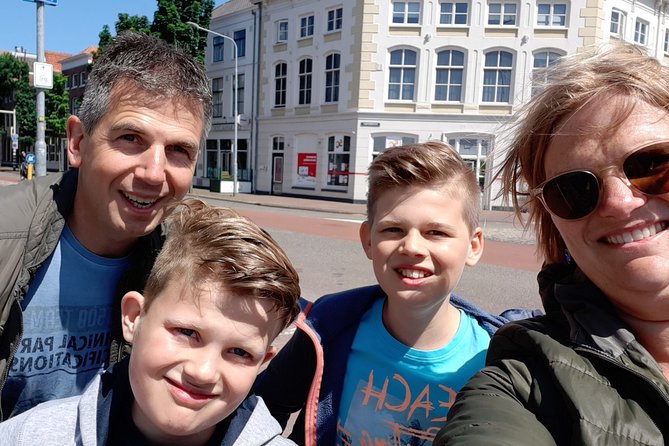
The activity begins at Stationsplein 6, near Kortrijk railway station, and ends back at the same meeting point. That is practical if you arrive by train or want to leave the city without arranging another pickup point.
You play through an online app on your phone. The game sends you from one location to the next, combining navigation with questions and small assignments. You are not following a guide’s fixed speech, so you can stop at a café, spend longer in a church, or pause the outing when younger members of your group need a break.
The advertised time is roughly two to four hours. That is a wide range, but it makes sense for a self-guided route. A quick group focused on the questions may finish near the shorter end. A family that stops to look around, shop, eat, or visit a museum could easily take longer.
At the start, give yourself a little time to understand the navigation. One person had to work out how the app directed the group to the next location, while another had to use Google to trace the route after the GPS stopped working. I suggest checking that your phone has enough battery and that your data connection is working before you begin.
More E-Scavenger Hunts in Ghent
- e-Scavenger hunt Ghent: Explore the city at your own pace
★ 4.5 · 41 reviews - Discover Ostend while playing! Escape game – The Walter case
★ 4.0 · 16 reviews - e-Scavenger hunt Ostend: Explore the city at your own pace
★ 4.5 · 10 reviews
The Beguinage, the first major history lesson
The Kortrijk Beguinage gives the route an excellent early stop. Founded in the 13th century, it has been a UNESCO World Heritage Site since 1998. You can stroll past its small houses, enter the courtyard, and visit the Mattheuskapel.
The site also carries a difficult history. The Beguinage was destroyed during the Battle of the Golden Spurs in 1302, after the Battle of Westrozebeke in 1382, and again by the French in 1684. The 41 cottages you see today date mainly from the 17th century.
This is a good example of what the game does well. Instead of treating the Beguinage as just a pretty group of old houses, it gives you a reason to look at the buildings and connect them to Kortrijk’s past. The courtyard is also a natural place to slow down and take in the setting.
Nearby, the route reaches Kortrijk 1302, a multimedia museum in the Beguinage Park. Housed in the Groeninge Abbey, it explores how the Battle of the Golden Spurs became part of Kortrijk’s public story and national mythology. The route also takes you to the Groeningepoort and the Groeningemonument, built for the battle’s 600th anniversary.
The repeated focus on 1302 may feel like a history lesson, but it helps explain why this date appears so often in Kortrijk. The game gives you several angles on the same event rather than treating it as an isolated fact.
Towers, churches, and medieval power

The route’s stop at the Lys towers reveals Kortrijk’s defensive and commercial role. The towers are built from limestone and sandstone, and the southern Speytorre dates from 1385. Its job was to help control traffic on the Lys.
This is a useful reminder that Kortrijk was not simply a collection of churches and squares. Its river mattered for movement, trade, and control. The tower stop also gives the walk a change of mood after the enclosed Beguinage.
The Church of Our Lady has an older foundation. Construction began in 1199 under Count Baldwin IX, and the church stood within Kortrijk’s castle domain. Its location connects religious power with the authority of the counts.
The route then takes you to St. Martin’s Church, or Sint-Maartenskerk. A place of worship existed here as early as around 650 AD. That date gives the church real weight, even before you study its architecture.
Another stop highlights a building whose façade uses a Gothic-Renaissance transitional style. Fourteen statues represent the counts of Flanders. This is the kind of detail that can be easy to miss during an ordinary walk, especially if you are more focused on finding lunch or the next street. The quiz gives you a reason to look upward.
The Passionists’ church, built in 1874, offers a later contrast. It is described as the archetypal church of popular devotion. Together, these churches show how Kortrijk’s religious buildings changed over many centuries.
The Belfry and the old cloth trade
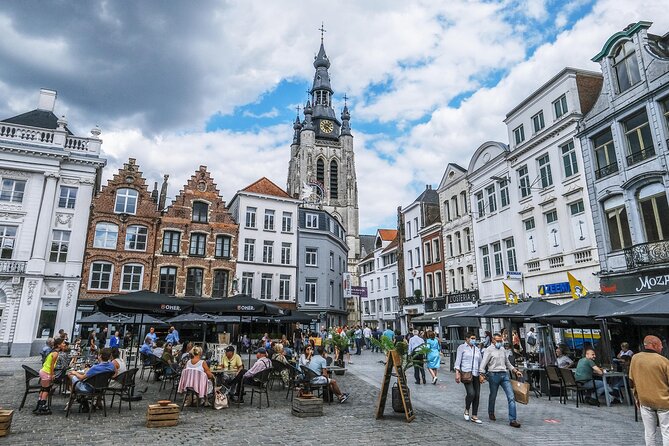
Kortrijk’s Belfry rises in the middle of the Grote Markt. It once formed part of the former cloth hall, first mentioned in 1248. That connection matters because cloth production and trade shaped the city’s wealth and identity.
The Belfry is one of the route’s most recognizable landmarks, but the app encourages you to see it as more than a photogenic tower. Look at its position in the market square and picture the commercial activity that once gathered around the cloth hall.
The game also brings you to the Baggaertshof, founded in 1638 by Joossine Baggaert. She created 13 cottages for women in need. The site adds a social side to the route, showing that Kortrijk’s old buildings are tied not only to merchants, rulers, and churches, but also to care for vulnerable people.
The former hospital courtyard offers another look at civic life. Its inner courtyard is one of the best-preserved 17th-century sites in Kortrijk. The word hospitalis originally referred to hospitality rather than illness, a small language detail that changes how you read the site.
These stops are especially useful if you like architecture with a human story. You get dates and styles, but you also encounter the people and institutions that used these places.
More self-guided city games in Ghent:
- Discover Mons while playing! Escape game – The alchemist
★ 4.0 · 5 reviews - Discover Ghent while playing! Escape game – The Walter case
★ 4.5 · 4 reviews - Discover Ghent while playing! Escape game – The alchemist
★ 4.0 · 4 reviews - e-Scavenger hunt Mons: Explore the city at your own pace
★ 5.0 · 4 reviews
Texture Museum and the Lys Valley connection
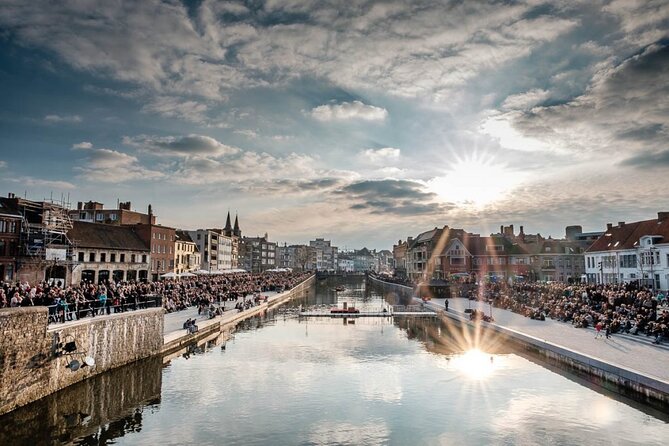
Texture, Kortrijk’s flax and linen museum, traces flax cultivation, processing, and the making of linen fabric. It places those activities within the development of the Lys Valley around Kortrijk.
The museum gives the route an important economic thread. The Belfry introduces the old cloth trade, while Texture shows how raw materials and skilled production supported the area. Even if you do not enter the museum, knowing what it represents helps explain why the Lys was so important.
A self-guided game cannot replace a full museum visit, and the supplied details do not state that admission is included. Treat Texture as a route landmark unless you separately confirm opening times and entry arrangements.
The Artillery Tower and the French connection
The Artillery Tower, also called the Armorie Tower, belongs to Kortrijk’s military story. It was built with the castle in 1301 and 1302 by Philip the Fair, the French king, during the Franco-Flemish war against the Count of Flanders.
This stop works well beside the battle memorials and the fortified towers. The route keeps returning to the pressures that shaped Kortrijk: French power, Flemish resistance, river traffic, walls, and civic defenses.
You will not get a long guided explanation at each site. Instead, the app gives you a fact, asks you to observe something, and keeps you moving. That format suits people who prefer a steady flow of short discoveries to a lecture.
Parks, roses, and a change of pace
The International Rose Garden dates from 1959 and sits in the grounds of Castle ’t Hooghe along Doorniksesteenweg. It gives the outing a softer, greener stop after the churches, towers, and war memorials.
The supplied route information does not promise that roses will be in bloom during your visit. The garden may still be worth seeing for its design and setting, but your expectations should match the season.
Another park takes its name from a visit by Queen Astrid on April 5, 1935. This is a small detail, yet it shows how the game uses civic stories alongside major history. You are not only chasing the most famous monuments. You are also collecting the facts that give Kortrijk its local character.
The route includes both central sights and less obvious areas. That broad reach is one of its best qualities, though it may also mean more walking than a simple loop around the Grote Markt.
Shopping stops and the reality of the route
K in Kortrijk is a shopping centre in the city centre with more than 80 shops and restaurants across 34,000 square metres. Ring Shopping, on Kortrijk’s outskirts, has about 90 shops and focuses on fashion, beauty, and lifestyle.
These stops may not appeal to everyone. If your main goal is medieval architecture, a shopping centre can feel like a detour. On the other hand, they give you practical places for a meal, coffee, a restroom break, or a rainy-weather pause.
The inclusion of Ring Shopping is worth noting because it is outside the central cluster of historic sights. The route may therefore feel less like a compact old-town walk and more like a broad city exploration. If you have limited time in Kortrijk, check the app’s route before beginning so you understand how much ground it covers.
Roadworks can also affect the experience. Some clues may be blocked or difficult to see, and construction changes can make navigation less clear. If an answer seems impossible, inspect the wider corner or nearby façade before assuming you have missed something.
How the questions and team play work
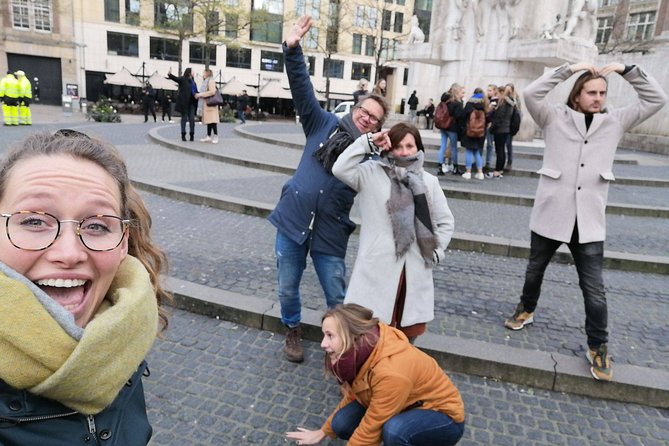
The questions are the heart of the experience. They turn passive sightseeing into a small group challenge, asking you to notice details on statues, façades, and public buildings.
One question involving the counts of Flanders caused confusion because a statue of Mary appeared to be included in the answer. That is a useful warning: read each question closely, and do not rush simply because you want to reach the next stop.
The game works particularly well with two teams. You can split a larger group into smaller teams and compare scores, though the advertised activity is for a team of no more than six people. Children can take part because many questions are suitable for them, but adults may need to help with navigation and historical details.
I like this format for families because the city itself becomes the activity. You do not need to keep children interested through a long speech. You give them a task, a landmark, and a reason to look carefully.
The game also suits people who already know Kortrijk. One local participant had attended school in the city and still discovered new places. That is a good sign for repeat visits, though the experience is not a substitute for a specialist guide if you want detailed architectural interpretation.
Price, timing, and practical value
At $37.33 per group of up to six, the price is reasonable when shared. A full group pays about $6.22 per person, while two people pay about $18.67 each. That compares well with many guided activities, especially since you control the start time and do not have to fit into a public group.
The value depends on how you use it. If you race from clue to clue and ignore the sites, you are paying for a game rather than a city introduction. If you pause at the Beguinage, read the church façades, take a break near the shopping areas, and allow up to four hours, the route becomes a useful framework for a full afternoon.
The activity is offered in English and runs daily from noon to midnight according to the stated operating hours. Confirmation arrives at booking, and cancellation is free up to 24 hours before the start time. Changes or cancellations within 24 hours are not refunded.
You need to bring your own smartphone and data. Service animals are allowed, public transportation is nearby, and the activity is described as suitable for most participants and user-friendly for people with hearing impairments.
Who should book this Kortrijk city game?
I would choose this activity for families, couples, friends, and small private groups who want to explore independently but still need a clear route. It is also a good choice if you dislike fixed tour schedules or want to stop for lunch without losing a guide.
The strongest reasons to book are the flexible pace, the group price, the mix of major sights and quieter locations, and the way the questions make you examine the city. The game has earned an overall rating of 4.3 from 15 ratings, with particular praise for being fun, educational, child-friendly, and useful for finding less touristy parts of Kortrijk.
I would hesitate if your phone connection is unreliable, if you need a fully guided explanation, or if construction is likely to block several clues. You should also allow extra time rather than treating the two-hour estimate as a promise.
Final verdict: a playful route through a serious old city
The Kortrijk e-Scavenger hunt is a smart way to get your bearings while learning why the city matters. It links the Beguinage, Golden Spurs memorials, Belfry, churches, towers, linen trade, parks, and shopping districts into one moving story.
Book it if you want independence with a little structure. Skip it if you prefer a quiet, guide-led walk with no technology. For most small groups, the low shared price and flexible format make this a worthwhile first look at Kortrijk, provided you bring a charged phone and stay ready for the occasional GPS or construction-related nuisance.
FAQ
Where does the Kortrijk e-Scavenger hunt start and finish?
It starts at Stationsplein 6, 8500 Kortrijk, Belgium, near the railway station. The activity ends back at the meeting point.
How long does the scavenger hunt take?
The expected duration is approximately two to four hours. Your total time depends on walking speed, breaks, sightseeing, and how carefully you complete the questions.
How many people can join one group?
The activity is designed for a private team of up to six people. Only your group participates.
Is a smartphone included?
No. The online app is included, but you must bring your own smartphone and mobile data.
What language is offered?
The scavenger hunt is offered in English.
Can I cancel for a refund?
Yes. You can receive a full refund if you cancel at least 24 hours before the experience start time. Cancellations or changes made within 24 hours are not refunded.
Just added around Ghent
- Ghent Running and Sightseeing Tour★ 5.0 · 3 reviews
- Ghent: Walking Tour from Friday Market to the Cathedral★ 4.8 · 3 reviews
- Ghent Walking Tour – City Highlights and Beyond Tradition★ 4.5 · 3 reviews
- Ghent: City Walk with Audio Guide in 7 Languages on your Phone★ 4.5 · 3 reviews
- Children’s escape game in the city of Ghent Marsupilami★ 5.0 · 3 reviews
- Discover Ghent while playing! Escape game – The Walter case★ 4.5 · 4 reviews
- Discover Ghent while playing! Escape game – The alchemist★ 4.0 · 4 reviews
- e-Scavenger hunt Mons: Explore the city at your own pace★ 5.0 · 4 reviews
E-Scavenger Hunts & City Games, compared.
e-Scavenger hunt Antwerp: Explore the city at your own pace
Read our review →
e-Scavenger hunt Bruges: Explore the city at your own pace
Read our review →
Bruges Scavenger Hunt and Highlights Self Guided Audio Tour
Read our review →

Beer Tasting and Scavenger Hunt in Brussels – About 3 Hours
Read our review →
e-Scavenger hunt Mechelen: Explore the city at your own pace
Read our review →
e-Scavenger hunt Hasselt: Explore the city at your own pace
Read our review →
e-Scavenger hunt Brussels: Explore the city at your own pace
Read our review →Browse the lists this tour appears in