

Reviewed · E-SCAVENGER HUNTS & CITY GAMES
e-Scavenger hunt Liège: Explore the city at your own pace
Liège rewards curious walkers. This self-guided smartphone game turns the city into a set of questions, search tasks, and GPS-guided stops, so you can discover major sights without following a guide holding up a flag. I like the freedom to start, pause, or stop when you choose, and I like the low group price, which covers up to six people. The main drawback is that you must manage the route yourself, and the app requires your own smartphone and data.
You begin near Place Saint-Paul and finish back at the meeting point. The route takes about three hours, but the flexible format means your actual pace is up to you. A private group can play together, making this a useful choice for families or friends who prefer a bit of friendly competition to a formal walking tour.
In This Review
- Key points at a glance
- How the Liège city game works
- Starting at Place Saint-Paul and Place Saint-Lambert
- Churches, opera, and the old central streets
- The Citadel slopes and Montagne de Bueren
- From Gare de Liège-Guillemins to Brasserie C
- La Batte, La Boverie, and the riverside section
- The Prince-Bishops’ Palace and central Liège
- Le Carré, a final church, and Le Pot au Lait
- Is $36.93 good value for six people?
- Who will enjoy this Liège activity?
- Booking, timing, and cancellation advice
- Should you book the Liège e-scavenger hunt?
- FAQ
- Where does the Liège e-scavenger hunt start?
- Where does the activity end?
- How long does the experience take?
- How many people can join one booking?
- Is this a private activity?
- Do I need a smartphone?
- Is mobile data included?
- Can I choose when to start?
- Is the activity suitable for people with hearing impairments?
- Can I cancel for a full refund?
Key points at a glance
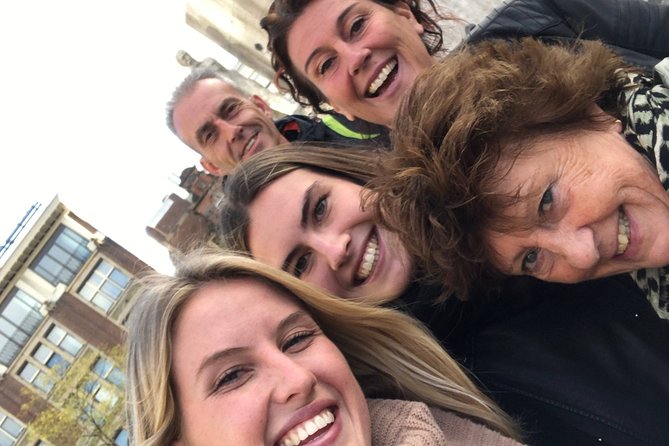
- A three-hour city game: Use your smartphone to answer questions and complete search assignments around Liège.
- Up to six people for $36.93: The price is per group, not per person, so the value improves with a full group.
- Twenty-three listed stops: The route includes Place Saint-Lambert, the Curtius Museum, Montagne de Bueren, La Boverie, and more.
- Start and stop freely: You can choose when to begin and pause the game when you need a coffee, meal, or museum visit.
- A private experience: Only your own group participates, with no strangers added to your team.
- Bring your own connection: A smartphone and mobile data are not included.
How the Liège city game works
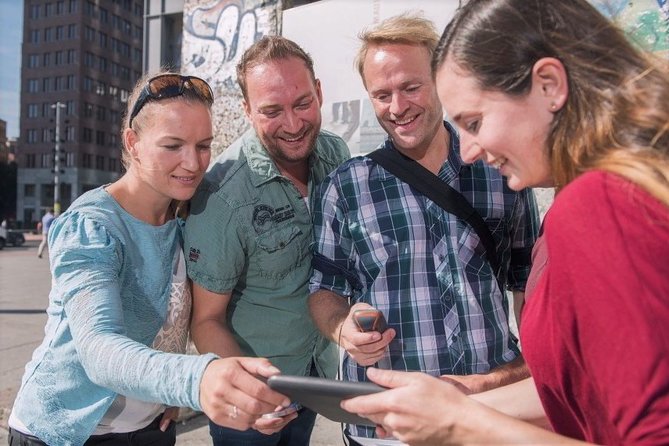
This is not a guided walk with a fixed departure time. After booking, you receive instructions for logging into the free city game app. GPS then helps you find squares, streets, monuments, and other points around Liège.
At each location, you answer questions or complete a search assignment. The activity is designed to be family-friendly, so the point is not simply to reach the next marker. You pay attention to your surroundings and use what you see to solve each task.
I like this setup for people who want some structure but dislike being locked into a guide’s timetable. You can stop for lunch, take a break, or spend extra time at a sight without losing the whole tour. The tradeoff is simple: you must keep the app working, follow the route, and organize your own movement through the city.
The listed duration is approximately three hours. Since there are 23 stops, that timing may feel brisk if you stop often or want to enter museums and churches. Think of the game as a sightseeing framework rather than a full guided visit inside every attraction.
More E-Scavenger Hunts in Liège
- Discover Durbuy by playing! Escape game – The alchemist
★ 3.5 · 14 reviews - Discover Dinant while playing! Escape game – The alchemist
★ 4.5 · 12 reviews - Liege Scavenger Hunt and Highlights Self Guided Audio Tour
★ 4.0 · 9 reviews
Starting at Place Saint-Paul and Place Saint-Lambert
The meeting point is Place Saint-Paul, at Pl. Saint-Paul, 4000 Liège. The first listed stop is Place Saint-Lambert, a major central square, followed by Liège City Hall. These opening points help you get oriented before the route spreads across the city.
Place Saint-Lambert gives the game a strong beginning because it is one of the city’s key public spaces. City Hall adds another central landmark, and the questions should encourage you to look closely instead of simply walking past.
The nearby central section also includes St. Paul’s Cathedral. It appears again later in the listed sequence, so do not be surprised if the app brings you back to the cathedral or presents it twice. The duplicate entry may reflect a route checkpoint rather than two entirely different visits.
Churches, opera, and the old central streets
The next group of stops brings together St. Paul’s Cathedral, the Opéra Royal de Wallonie-Liège, Eglise Saint-Antoine et Sainte-Catherine, and the Curtius Museum. This is a good mix for a city game because you move between religious buildings, performing arts, and museum culture.
The opera house gives the route a change of mood. You are not looking only at medieval or civic sights. The nearby church stops add architectural variety, while the Curtius Museum provides a clear cultural landmark to locate and identify.
The game format works best here if you resist the urge to rush from one GPS point to the next. Read the questions carefully, look at building details, and give your group a moment to compare answers. You may not receive the same depth of explanation that a live guide could offer, but the tasks make you more alert to the city around you.
If you hope to tour the Curtius Museum itself, allow extra time beyond the suggested three hours. The activity includes the museum as a stop, but the supplied details do not say that museum admission or an interior visit is part of the game.
The Citadel slopes and Montagne de Bueren

The route then heads toward the Coteaux de la Citadelle and Montagne de Bueren. This is likely the most physically demanding part of the experience because the Citadel slopes and the famous stairway involve uphill walking and steps.
Montagne de Bueren is an especially useful stop for a self-guided game. A long stairway is easy to recognize, and the app can turn the climb into a challenge rather than just another photo stop. Still, pace yourself. If someone in your group dislikes steep routes, this section may be less enjoyable than the central squares.
The Coteaux de la Citadelle adds open space and changing views over Liège. I would save a little time here instead of treating it as a quick checkpoint. The activity is designed to be paused, so you can stop, catch your breath, and continue when ready.
The route also includes Eglise St-Jacques and Eglise St-Barthélemy. These church stops break up the outdoor walking and give you quieter places to study details. The app supplies facts and questions, but the exact amount of historical explanation is not specified, so you should see the game as an introduction rather than a specialist church tour.
More self-guided city games:
- Discover the secrets of Namur while playing! Escape room
★ 4.0 · 5 reviews - e-Scavenger hunt Namur: Explore the city at your own pace
★ 3.5 · 5 reviews - Discover Liège while playing! Escape game – The Walter case
★ 4.5 · 5 reviews - e-Scavenger hunt Antwerp: Explore the city at your own pace
★ 4.5 · 67 reviews
From Gare de Liège-Guillemins to Brasserie C

Gare de Liège-Guillemins is another listed stop. Its inclusion widens the route beyond the old center and shows that the game is not limited to traditional monuments. The station may require more walking from the central sights, depending on the order the app assigns on the day you play.
Brasserie C appears next. It offers a practical reminder that Liège is also a place to eat and drink, not only a collection of churches and monuments. The supplied information does not say that a tasting, meal, or drink is included, so treat it as a location in the game rather than a food stop included in your booking.
This is one point where route planning matters. You control the timing, but the app controls the challenges and GPS prompts. If the path feels too long for your group, pausing the activity is allowed. You can also check the route before setting out and make sure your phone has enough battery and data.
La Batte, La Boverie, and the riverside section

The route includes Marché de la Batte, La Boverie, and Parc de la Boverie. These stops give the game a different rhythm, moving away from concentrated historic streets toward market, museum, park, and riverside settings.
Marché de la Batte is a natural place for observation-based questions because it is a public market location. The opening hours supplied for the activity are listed as every day from midnight to 11:59 p.m., but that does not confirm that the market itself operates at all those times. If seeing the market matters to you, check its own schedule before choosing your start time.
La Boverie and Parc de la Boverie provide another useful pairing. One stop focuses on the cultural venue, the other on the surrounding park. You can pause here if your group needs a quieter stretch, but remember that the price covers the game, not stated museum admission.
Pont de Fragnée is also included. Bridges make good navigation markers, and this stop adds a clear crossing point to the route. Together, the park, museum, market, and bridge prevent the experience from feeling like a checklist of old churches.
The Prince-Bishops’ Palace and central Liège
Palacio de Los Principes-Obispos, or the Prince-Bishops’ Palace, is one of the route’s major historic landmarks. It joins Place du Marché and the Statue of Georges Simenon, giving you a compact group of civic and cultural points to find.
The statue of Georges Simenon adds a literary connection to the route. You are not only hunting for grand buildings. The game also asks you to notice public art and figures connected with the city.
Place du Marché brings you back to a central public square. This part of the route should suit families because the tasks can make ordinary urban spaces feel like clues. At the same time, you should not expect every stop to be a major monument. Some are there to keep the game moving and to make you look at Liège as a whole.
Le Carré, a final church, and Le Pot au Lait
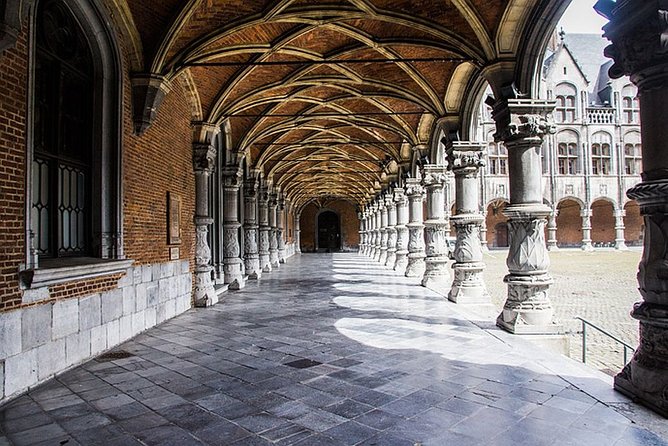
The final group includes Le Carré, Eglise Notre-Dame-de-l’Immaculée-Conception, and Le Pot au Lait. Le Carré is known here as a named city area, while the church gives the route one more architectural checkpoint.
Le Pot au Lait is a distinctive final location for a city game. The supplied details do not promise food, drinks, or entry, so consider it another place to identify through the app. If you want to stop for refreshments, you can pause the activity, but any purchase would be your own responsibility.
The route ends back at the meeting point. Because the activity includes far-flung stops such as Gare de Liège-Guillemins and Pont de Fragnée, I would keep an eye on the app’s instructions rather than assume the listed order forms the most efficient walking loop. GPS guidance is central to the experience.
Is $36.93 good value for six people?
At $36.93 per group of up to six, this is inexpensive when shared. A full group pays roughly $6.16 per person before any food, transport, or admissions. Even a smaller group can find value here if you want three hours of organized sightseeing without paying for a private guide.
The price includes a city trail and the app-based game. It does not include a smartphone or data, and there is no stated inclusion for museum entry, meals, drinks, or public transport. Those exclusions matter because the route covers many stops and may tempt you to add other activities.
The best value comes from treating the game as a flexible way to see Liège’s main areas. It is less compelling if you want detailed commentary at every church, a carefully paced walking tour, or someone else to handle navigation.
The activity has a 3.8 rating from 16 ratings, which suggests a mixed but usable experience. One low rating focused on the amount of self-management and a lack of response when trying to move the visit. A five-star rating praised the way the game made discovering Liège enjoyable. I would take both points seriously: the fun depends on your group taking charge, and you should plan your date carefully before booking.
Who will enjoy this Liège activity?
I would recommend it most to families, couples, and groups of friends who like puzzles, walking, and independent sightseeing. It also suits larger groups because each booking is private and one game can include up to six people.
You should choose it if you want to start at a time that fits your day, pause without asking permission, and decide how quickly to move. It is also a good option for people who find standard guided tours too formal.
I would be more cautious if you want a live expert, a precise historical lecture, or a route with no uphill walking. The Citadel section and Montagne de Bueren may be demanding, and the long list of stops could feel rushed in three hours.
The activity is user-friendly for people with hearing impairments, and service animals are allowed. It is near public transportation, and most people can participate. You still need your own smartphone and data, so check those basics before you set out.
Booking, timing, and cancellation advice
You can book for any day during the stated operating period, from February 16, 2020 through December 7, 2026. The listed hours run from 12:00 a.m. to 11:59 p.m. daily, which supports the flexible format, though you should remember that individual sights and businesses may keep different hours.
Confirmation is provided at booking, with starting instructions sent afterward. Since one low rating described difficulty getting a response about changing the date, I would choose your timing carefully and avoid relying on a last-minute adjustment.
Free cancellation is available if you cancel at least 24 hours before the start time. Inside that 24-hour window, you receive no refund, and changes are not accepted. The cut-off uses Liège local time.
Should you book the Liège e-scavenger hunt?
Book it if you want a low-cost, private way to cover a wide section of Liège while keeping control of your day. The combination of GPS clues, questions, and search tasks gives a simple city walk more purpose, and the group price is particularly fair for six people.
Skip it if you want a guide to explain every landmark or if you dislike handling your own route. Bring a charged smartphone, confirm your data access, allow extra time for the Citadel slopes, and treat the three-hour estimate as a guide rather than a strict promise. For the right group, this is a playful introduction to Liège, with enough freedom to make the city your own.
FAQ
Where does the Liège e-scavenger hunt start?
It starts at Place Saint-Paul, Pl. Saint-Paul, 4000 Liège, Belgium.
Where does the activity end?
The activity ends back at the meeting point.
How long does the experience take?
The estimated duration is approximately three hours.
How many people can join one booking?
One city trail is for a team of up to six people.
Is this a private activity?
Yes. Only your group participates.
Do I need a smartphone?
Yes. The game uses a smartphone app, and a smartphone is not included.
Is mobile data included?
No. You need to provide your own data connection.
Can I choose when to start?
Yes. You can do the activity at a time you choose during the listed opening period.
Is the activity suitable for people with hearing impairments?
The experience is described as user-friendly for hearing-impaired participants.
Can I cancel for a full refund?
Yes, if you cancel at least 24 hours before the experience start time. Cancellations within 24 hours are not refunded.
Just added around Liège
- Children’s escape game in the city of Liège Marsupilami★ 4.0 · 3 reviews
- Namur: Escape Game in the city – The Alchemist★ 4.0 · 5 reviews
- Discover the secrets of Namur while playing! Escape room★ 4.0 · 5 reviews
- e-Scavenger hunt Namur: Explore the city at your own pace★ 3.5 · 5 reviews
- Discover Liège while playing! Escape game – The Walter case★ 4.5 · 5 reviews
- Hamoir “Les Remous”:Kayak 8,4km★ 4.1 · 8 reviews
- Liege Private Walking Tour★ 4.3 · 10 reviews
- Castle Guided Tour (English)★ 4.0 · 16 reviews
E-Scavenger Hunts & City Games, compared.

e-Scavenger hunt Antwerp: Explore the city at your own pace
Read our review →
e-Scavenger hunt Bruges: Explore the city at your own pace
Read our review →
Bruges Scavenger Hunt and Highlights Self Guided Audio Tour
Read our review →

Beer Tasting and Scavenger Hunt in Brussels – About 3 Hours
Read our review →
e-Scavenger hunt Mechelen: Explore the city at your own pace
Read our review →
e-Scavenger hunt Hasselt: Explore the city at your own pace
Read our review →
e-Scavenger hunt Brussels: Explore the city at your own pace
Read our review →Browse the lists this tour appears in