
Reviewed · PRIVATE
Flanders World War I Battlefields Private Tour from Brussels
Memory lives in Flanders’ fields. This long private day trip from Brussels takes you through the Ypres Salient, where memorials, cemeteries, bunkers, museums, and scarred ground tell the story of World War I. I like the private vehicle and hotel pickup, which save you from renting a car and let you focus on the countryside and your guide’s commentary. I also like the range of stops, from the modern In Flanders Fields Museum to quiet cemeteries and Hill 60’s old battlefield ground.
The main drawback is the price: $889.89 per person is a serious spend, even with transport, bottled water, WiFi, and museum admission included. The day can also run 8 to 10 hours, and lunch is not included. One especially useful point is that the experience is private, so your group can travel at its own pace, though the quality of the day depends heavily on your guide and how clearly the schedule is explained.
In This Review
- Key points to know before booking
- Why this Brussels day trip is worth considering
- Riding from Brussels to the Ypres Salient
- St Julien and Polygon Wood: memorials in open country
- Poelkapelle and the Ypres Salient
- In Flanders Fields Museum: the day’s main indoor stop
- Essex Farm and the story behind In Flanders Fields
- Hill 60: craters and underground warfare
- Tyne Cot Cemetery and the scale of loss
- Lunch and free time in Ieper, also called Ypres
- Menin Gate and the Last Post ceremony
- The guides, vehicle, and private format
- Is $889.89 per person good value?
- Who should book this Flanders battlefield tour?
- Should you book it?
- FAQ
- Where does the Flanders World War I Battlefields tour begin?
- How long does the tour last?
- Is this a private tour?
- Is transportation included?
- Is admission to the In Flanders Fields Museum included?
- Is lunch included?
- What happens if I cancel?
Key points to know before booking
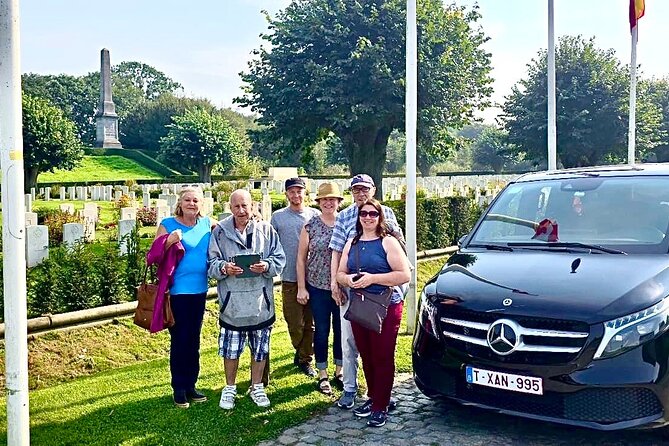
- Private pickup from Brussels: Your group receives hotel pickup and drop-off in an air-conditioned vehicle, with no need to navigate Belgian roads.
- A full Ypres Salient circuit: The route includes St Julien, Polygon Wood, Poelkapelle, Essex Farm, Hill 60, Tyne Cot, Ypres, and the Menin Gate.
- Museum admission included: Your ticket covers the In Flanders Fields Museum in Ypres.
- A serious history day: The focus is World War I, not general sightseeing, so this suits people willing to spend most of the day with memorials and military history.
- Lunch is on your own: You get free time in Ypres, but the meal is not covered and may come fairly late in the day.
- Guide quality matters: Henry is praised for clear, well-informed explanations, while Marikea is noted for connecting the tragedy of the battlefields with the museum and crater sites.
Why this Brussels day trip is worth considering
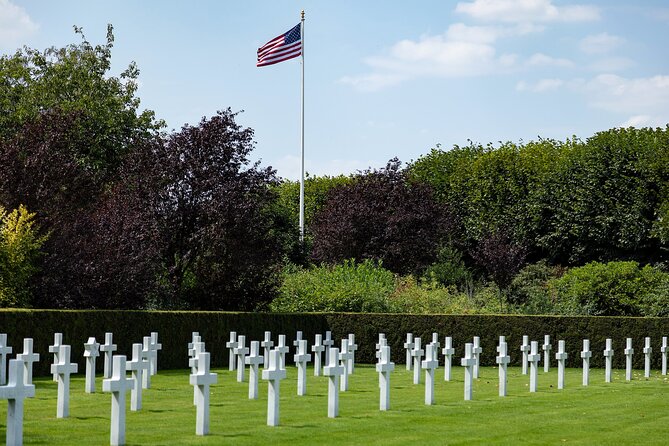
Flanders is easy to reach in theory, but the battlefield sites are spread across rural West Flanders. They are not arranged as one neat museum district. A private car and guide remove much of the practical work: you do not need to work out the route between cemeteries, identify which memorial belongs to which army, or find parking at several separate sites.
I value this kind of arrangement most when the subject needs context. A cemetery can look peaceful and orderly, but without knowing what happened nearby, it is easy to miss why that particular place matters. The guide helps connect the names, units, dates, and sites.
The route also gives you several ways to approach the war. The In Flanders Fields Museum provides a broad account. Essex Farm links the war to medical care and the poem In Flanders Fields. Hill 60 shows the physical effect of fighting and tunneling. Tyne Cot and the Menin Gate bring the human cost into view through graves and names.
This is not a quick photo stop tour. At several places, you will get out and walk, although the supplied timings are fairly short at some sites. The experience works best if you are comfortable with a packed schedule and want an introduction to the main locations rather than hours at one battlefield.
A few more trips and experiences worth a look
- Brussels: Atomium Entry Ticket with Design Museum Ticket
★ 4.4 · 9,254 reviews - From Brussels: Guided Day Trip to Bruges and Ghent
★ 4.6 · 8,353 reviews - From Brussels: Bruges & Ghent Day Tour – 2 Fairytale Cities
★ 4.7 · 8,242 reviews
Riding from Brussels to the Ypres Salient
The day begins with pickup in Brussels and transport in a private, air-conditioned vehicle. Bottled water and WiFi are included, useful comforts on a long day with considerable time on the road. Round-trip transport is one of the clearest reasons to consider this option, especially if you do not want to rent a car.
The drive takes you through the Belgian countryside toward Ypres and the surrounding battlefield area. The route is not simply a transfer to one museum. You are using the vehicle to link sites that are separated across the former front.
A private tour also gives you more control than a large coach excursion. Only your group participates, and group discounts may be available. Still, private does not automatically mean leisurely. With eight planned stops and a total duration of roughly 8 to 10 hours, the schedule needs to stay on track.
One practical concern is communication. A clear map or written outline would help you understand where you are going and how the day is unfolding. Make sure you ask your guide at the start about the order of stops, lunch timing, and the museum visit. That small bit of planning can make a long day feel much easier.
St Julien and Polygon Wood: memorials in open country
The first listed stop is the St Julien Memorial, also called the Brooding Soldier. This Canadian memorial remembers the men who fought in the Second Battle of Ypres. Its design gives the place a quiet, reflective mood rather than the feel of a grand civic monument.
You then see Polygon Wood and the 5th Australian Division Memorial. The name Polygon Wood is familiar to anyone studying the Ypres battles, but the site itself is more subdued than a city museum. That is part of its value. You are looking at a rural place and trying to picture the artillery, trenches, mud, and movement that once filled it.
The planned time here is about 40 minutes, with no separate admission charge. That should be enough for an explanation and a measured look around, but not a long study of every plaque. Listen closely to the guide’s location-based explanation, since the significance may not be obvious from the setting alone.
I would treat this opening section as preparation for the rest of the day. It introduces the Canadian and Australian presence in the Ypres area and shows that the fighting extended far beyond the best-known gate and cemetery.
Poelkapelle and the Ypres Salient
The Tank Memorial at Poelkapelle brings the military machinery of the war into the story. It is linked to the Ypres Salient, the area around Ypres that saw several major World War I battles. The stop lasts about an hour and does not require an admission ticket.
The Ypres Salient is important because it was not one single battlefield in the modern sense. It was a broad zone of repeated attacks, defensive lines, and shifting positions. The guide’s role here is particularly useful, since a memorial or tank by itself cannot explain the wider pattern of the fighting.
You should expect some time outside, so wear shoes suitable for walking and dress for Belgian weather. That advice is practical rather than dramatic. The tour moves between open memorial areas, cemeteries, museum rooms, and town streets, so comfort matters across the whole day.
This stop also helps balance the later cemetery visits. You see a reminder of how warfare changed, then move into places where the focus turns back to individual lives and names.
Something different, still within reach of Brussels:
- Choco-Story Brussels: Chocolate Museum Entrance with Tasting
★ 4.3 · 4,883 reviews - Bruges and Ghent – Belgium’s Fairytale Cities – from Brussels
★ 4.0 · 4,809 reviews - Brussels: Hop-On Hop-Off Bus Tour
★ 4.0 · 4,016 reviews - Brussels: Guided Walking Tour
★ 4.6 · 3,560 reviews
In Flanders Fields Museum: the day’s main indoor stop
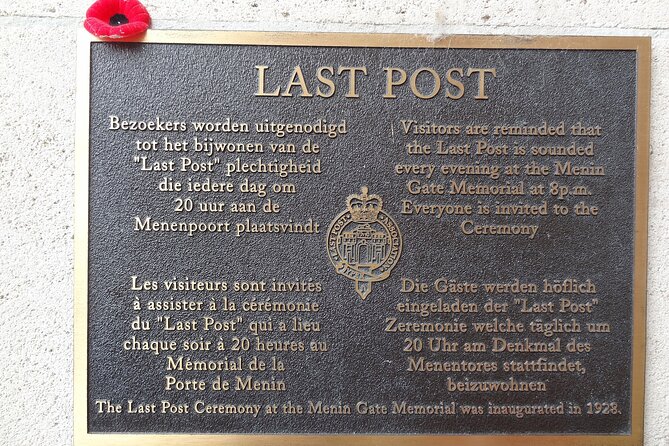
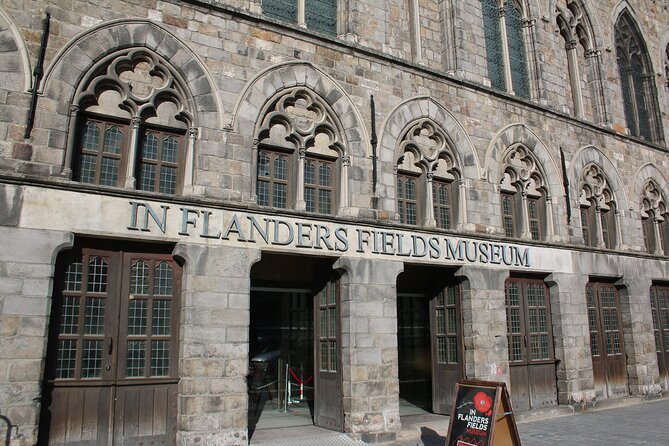
The In Flanders Fields Museum in Ypres is the central museum visit, and admission is included. You have about an hour inside, which gives you a useful introduction to the war in Flanders without turning the entire day into an indoor museum visit.
The museum focuses on the human effects of the conflict, not only troop movements and equipment. Its setting in Ypres matters. The city itself was heavily tied to the fighting, and the museum helps explain why this small Belgian town became such a powerful symbol of World War I.
An hour is enough for a focused visit, but it is not enough to examine every display at a slow pace. I would arrive ready to choose. Read the introductory material, follow the sections that explain the local battles, and save enough time for the exhibits that connect the broad war to personal stories.
The museum is an especially valuable part of the day for anyone who has not studied the Ypres battles before. It gives you the basic framework needed for the outdoor stops. Without it, the names of places and divisions can blur together.
One point deserves attention: museum entry is included in the price, so confirm with your guide that this stop is part of your schedule. A clear check at the beginning avoids losing one of the day’s most useful elements.
Essex Farm and the story behind In Flanders Fields
At Essex Farm Cemetery, you see a former dressing station and wartime bunkers. The site is associated with John McCrae, the Canadian soldier linked to the poem In Flanders Fields. The stop lasts about 30 minutes and has no separate admission cost.
This is one of the most personal stops on the route. The poem is widely known, but Essex Farm gives it a specific place. You are not simply hearing a famous title in a classroom or reading it on a souvenir. You are visiting the medical and military setting connected with McCrae’s service.
The bunkers also remind you that battlefield sites were working places. Wounded men were treated, soldiers passed through, and medical staff operated under dangerous conditions. The cemetery then brings the focus to those who did not return.
Thirty minutes is a short visit, but it can be enough if the guide explains the site well. I would use this time to listen rather than rush through photographs. The connection between the bunkers, the dressing station, the cemetery, and the poem is the point.
Hill 60: craters and underground warfare
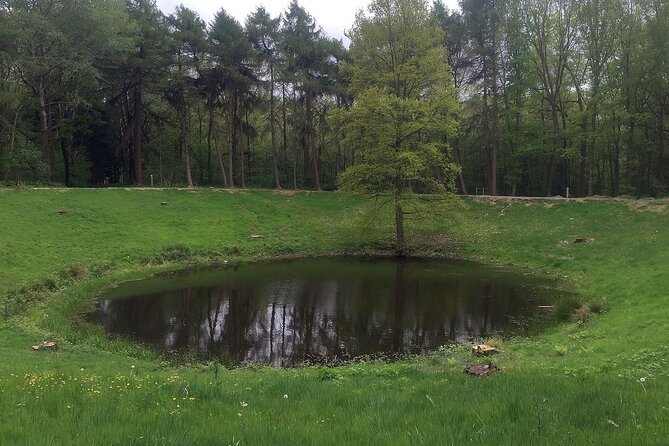
Hill 60 is one of the more physical stops. You walk up to a raised area that saw fierce fighting, including underground operations. The planned visit lasts around 30 minutes.
Unlike a traditional memorial, Hill 60 makes you think about the ground itself. The height mattered militarily, and the tunnels beneath it added another layer of danger. The site helps explain why control of a seemingly modest rise could cost so many lives.
The walking here is part of the experience. You may encounter uneven ground, so sensible footwear is important. The available information does not promise a long hike, but this is not a stop you should approach in delicate city shoes.
A guide can make a major difference at Hill 60. The craters and raised ground do not tell their own story to every first-time visitor. One review specifically praised a tour that included a walk through the craters at Hill 60, along with the museum and another local museum. That combination shows why the outdoor and indoor parts work well together.
Tyne Cot Cemetery and the scale of loss
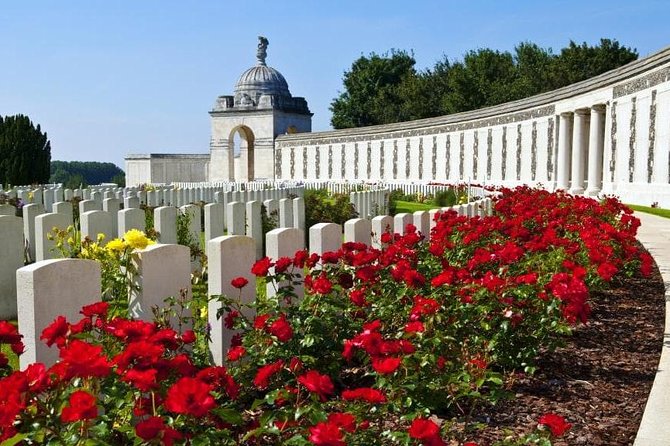
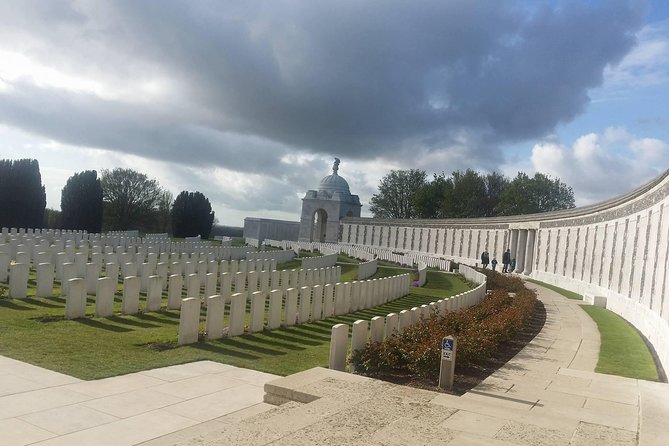
Tyne Cot Cemetery is one of the most important cemetery stops on the route. Many soldiers who died in the Ypres Salient are buried here, while the Tyne Cot Memorial to the Missing records names on the wall surrounding the cemetery.
The planned stop is about 30 minutes. That is enough to enter, see the cemetery layout, and spend time at the memorial, but you will need to be selective. The scale of the names can be difficult to take in quickly, and the short time may feel limiting if you want to read individual entries.
Tyne Cot is a place for quiet attention. The rows of graves create order, but the number of names points to the disorder and loss of the fighting. I find that this contrast is one of the strongest parts of a battlefield day: neat memorial spaces cannot make the numbers feel small.
Ask your guide to explain how Tyne Cot fits into the Ypres Salient and why the memorial includes names of men with no known grave. That context turns a brief visit into something more meaningful.
Lunch and free time in Ieper, also called Ypres
The tour gives you free time in Ypres for lunch and a look around town. Lunch is not included, so you pay for your own meal. The timing may be late, around 2:15 according to one account, so bring patience and consider eating a solid breakfast.
This is the least structured part of the day, and that is useful after several memorials. You can pause, find food, and see a little of Ypres at your own pace. The free time also breaks up the emotional weight of the battlefield stops.
At the same time, one minute is shown for the town portion, which clearly does not describe a meaningful sightseeing period by itself. Treat Ypres as a lunch break with some independent time, not as a full city tour. If seeing the town is a priority, ask exactly how much time you will have before you book.
The late lunch issue matters more than it might seem. By this stage, you will have been on the road and walking outside. A delayed meal can affect your energy for the Menin Gate and the journey back to Brussels.
Menin Gate and the Last Post ceremony
The Menin Gate Memorial in Ypres is the final major stop. Its walls carry the names of thousands of missing Commonwealth soldiers. The scheduled time is about 1 hour and 30 minutes, making it one of the longer stops of the day.
This is where the individual battlefield sites come together. You have seen cemeteries, bunkers, memorials, and the former front area. At the gate, the names are gathered in a major public memorial within Ypres itself.
The tour includes time connected with the Last Post ceremony, described in the experience details as a Las Post ceremony. Confirm the exact timing with your guide, since the ceremony schedule is central to planning the final part of the day. If it is included in your visit, allow yourself a quiet moment and do not expect to rush in and out.
The Menin Gate can be emotionally heavy, especially after Tyne Cot and Essex Farm. That is not a reason to skip it. It is a reason to pace yourself and understand that the day ends on a reflective note rather than with a light sightseeing attraction.
Afterward, you return to Brussels in the private vehicle. The ride gives you time to rest, but the arrival time depends on traffic, the length of earlier stops, and the ceremony schedule.
The guides, vehicle, and private format
The strongest comments about the experience focus on the people leading it. Henry is described as articulate and well informed, while Marikea is praised for linking the modern museum, a rustic museum at Hill 62, and the craters at Hill 60. These details suggest that the guide can shape the day from a simple transfer between sites into a connected story.
Adel, the driver, is praised for safe driving and for making an extra effort with an unplanned return destination. That kind of flexibility is useful at the end of a long day, though you should not assume every special request can be accommodated.
The vehicle is air-conditioned, private, and equipped with WiFi. Hotel pickup and drop-off in Brussels are included. Service animals are allowed, the tour is near public transportation, and most people can participate. Children must be accompanied by an adult.
Because only your group takes part, you can ask questions freely. You can also tell the guide if you need a little more time at a cemetery or less time at a particular stop. Still, the published schedule is busy, so flexibility has limits.
Is $889.89 per person good value?
At $889.89 per person, this is not a budget day trip. The price pays for a private vehicle, pickup and drop-off, a driver, a guide, bottled water, onboard WiFi, and entry to the In Flanders Fields Museum. It also saves you the work of renting a car and building a route across scattered sites.
The value depends on your group size and priorities. For a small group that wants private transport and strong historical guidance, the convenience may justify the cost. For one person or a couple comparing standard group excursions, the price will feel high.
The private format is the key difference. You are paying for control, comfort, and a dedicated guide rather than only for admission to a museum or memorial. If you already have access to a car and are happy to research the battlefields yourself, you may find cheaper ways to visit the area.
The limited public feedback is mixed in an important way: the historical guidance and driving receive strong praise, while one account calls the tour expensive and points to the lack of a clear map or itinerary, a missed museum entry, and a late lunch. That is useful advice. Before setting off, confirm every included item and ask for the day’s order.
Who should book this Flanders battlefield tour?
I would recommend it most to:
- People with a strong interest in World War I
- Families or small groups that value a private vehicle
- Visitors staying in Brussels who do not want to drive
- Anyone who wants both a museum explanation and outdoor battlefield sites
- Those willing to spend a full day on memorials, cemeteries, and military history
I would be more cautious if you want a relaxed Belgian countryside outing, broad sightseeing, or a long lunch in Ypres. The subject is solemn, and the pace is fairly full.
Wear comfortable shoes, plan for changing weather, eat breakfast, and ask about lunch timing. Also confirm that the museum visit and ceremony timing are included in your particular schedule. Those simple checks address the main practical concerns.
The cancellation terms are generous if your plans change: you can receive a full refund when you cancel at least 24 hours before the start time. Cancellations inside 24 hours are not refunded, and changes are not accepted during that period. The tour also requires a minimum number of participants, with another date or a full refund offered if that minimum is not met.
Should you book it?
Book this tour if you want a focused, private introduction to the Flanders battlefields and value having a guide explain why each site matters. The mix of Ypres, the In Flanders Fields Museum, Essex Farm, Hill 60, Tyne Cot, and the Menin Gate gives you a solid first look at the area.
Think twice if the price strains your budget or if you prefer to spend long periods at fewer places. At this cost, you should confirm the route, museum admission, lunch break, and Last Post timing before departure.
For a history-minded group based in Brussels, the private transport and guide support make the high price easier to defend. Just go in prepared for a long, solemn day rather than a casual sightseeing excursion.
FAQ
Where does the Flanders World War I Battlefields tour begin?
The tour begins in Brussels and includes hotel pickup and drop-off within Brussels.
How long does the tour last?
The experience lasts approximately 8 to 10 hours.
Is this a private tour?
Yes. Only your group participates in the private tour or activity.
Is transportation included?
Yes. Round-trip private transportation in an air-conditioned vehicle is included, along with WiFi and bottled water.
Is admission to the In Flanders Fields Museum included?
Yes. Entry to the In Flanders Fields Museum is included in the tour price.
Is lunch included?
No. You receive free time in Ypres for lunch, but the meal is at your own expense.
What happens if I cancel?
You receive a full refund if you cancel at least 24 hours before the experience start time. Cancellations or changes made less than 24 hours before the start time are not accepted or refunded.
Just added around Brussels
- Discover the secrets of Brussels while playing★ 5.0 · 3 reviews
- Standard vehicle from Charleroi airport to city of Brussels★ 4.5 · 3 reviews
- Full day Brugge & Ghent: the gems of Flanders★ 5.0 · 3 reviews
- Private tour : Best of Brussels half day From Brussels★ 5.0 · 3 reviews
- Private Tour – Bruges and Ghent, our fairytale cities★ 5.0 · 3 reviews
- Floating in the clouds★ 5.0 · 3 reviews
- Full-Day City Tour of Ghent and Bruges from Brussels★ 4.5 · 3 reviews
- Brussels Private Walking Tour With A Professional Guide★ 4.5 · 3 reviews
Private, compared.

Private Historical Tour: The Highlights of Bruges
Read our review →

Brussels Highlights & Hidden Gems Private Tour with a Local Guide
Read our review →
Belgian Beer Tasting and Course at a Private Bar
Read our review →
Highlights & Hidden Gems With Locals: Best of Bruges Private Tour
Read our review →
The 10 Tastings of Bruges With Locals: Private Food Tour
Read our review →
From Bruges to Damme: Private Electric Scooter tour
Read our review →Browse the lists this tour appears in