
Reviewed · FLANDERS FIELDS & WWI TOURS
From Ypres: WWI Battlefields Private Tour
The fields around Ypres still carry the marks of war. I like the chance to walk original trenches at Sanctuary Wood, and I love how guides such as Søren Hawkes and Sabine connect battle sites to individual soldiers and family stories. The private vehicle also lets you move between scattered sites without wrestling with country roads or a timetable.
The main drawback is the short four-hour schedule. You can cover the major Australian, Canadian, New Zealand, South African, and British sites, but this is an introduction rather than a full study of the Ypres Salient. Some stops, especially the cemeteries, call for quiet time, so the day can feel brisk if your interests are wide.
In This Review
- Key points at a glance
- Why a private Ypres battlefield tour works
- Starting in Ypres with the right expectations
- Caterpillar Mine Crater at Hill 60 B
- Sanctuary Wood and its preserved trenches
- Tyne Cot Cemetery and the scale of loss
- The Brooding Soldier memorial
- John McCrae’s dressing station and Essex Farm
- A guide who adapts the story to you
- How much can you really see in four hours?
- Who will get the most from this tour?
- Should you book this Ypres battlefield tour?
- FAQ
- How long is the Ypres WWI battlefield tour?
- What is included in the price?
- How many people can join the private tour?
- Can the tour include an ancestor’s grave or battle site?
- Which national battlefield routes are available?
- What should I bring?
Key points at a glance

- Original trench walking: Sanctuary Wood gives you a rare chance to walk through preserved WWI trench lines rather than viewing them only from a distance.
- The Caterpillar mine crater: The huge crater at Hill 60 B shows the force of the 1917 underground mine explosion.
- Family-focused guiding: Send ancestor details in advance, and the guide can work relevant graves, units, and battle locations into the route when possible.
- Three national routes: Choose an Australian 1917, Canadian 1915 and 1916/1917, or Kiwi 1917 focus.
- Tyne Cot and Essex Farm: The tour links battlefield action with cemeteries and memorials, making the military story personal.
- A genuinely private format: The $530 price covers up to four people, with pickup and drop-off in Ypres.
Why a private Ypres battlefield tour works
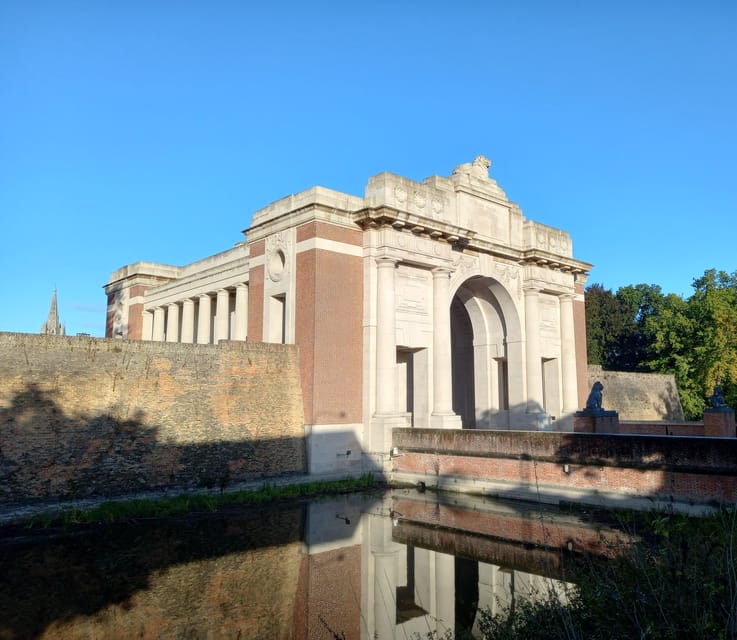
Ypres is a good base for visiting the First World War sites, but the places are spread across the surrounding farmland. A private car saves you from trying to connect cemeteries, memorials, museums, and old battle positions on your own.
The price is $530 per group of up to four. That works out to $132.50 per person for a full vehicle, guide, hotel pickup, drop-off, mineral water, and museum admission. For two people, it is a much bigger spend, but you are paying for personal attention and a route shaped around your interests rather than a fixed coach itinerary.
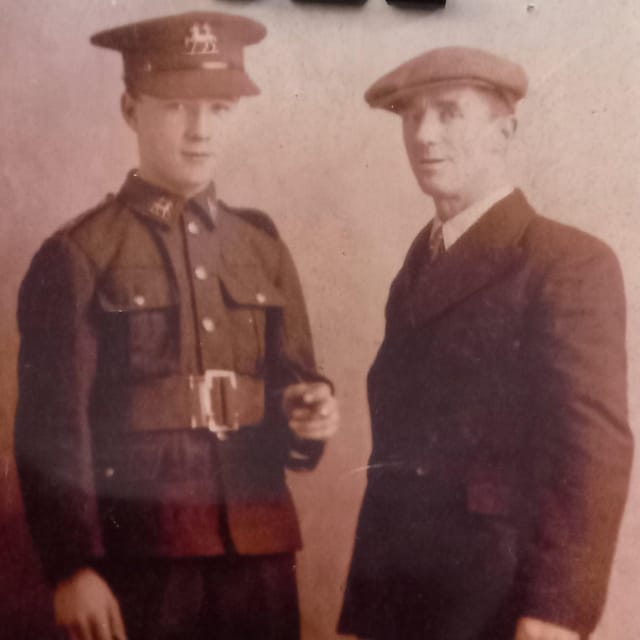
That personal format matters most if you have a family connection. One guide read a guest’s grandfather’s diary and service record before the tour. Another helped locate an ancestor’s grave and adjusted the route around New Zealand family history. This is the sort of preparation that can turn a general history outing into a meaningful day.
You can also choose a national focus. The Australian route follows the 1917 fighting around Ypres, the Canadian route covers Canadian action in 1915 and 1916/1917, and the Kiwi route concentrates on New Zealand forces in 1917. Mixed groups can still be accommodated, as one party combining Australian, New Zealand, and American interests found.
More Flanders Fields and WWI trips:
- From IEPER Private 4-hour Tour of the Ypres Battlefield
★ 5.0 · 154 reviews - In Flanders Fields and Passchendaele Half Day Morning Tour
★ 5.0 · 117 reviews - Ypres: An exploration of the deadly salient battlefields
★ 5.0 · 76 reviews
Starting in Ypres with the right expectations
Pickup is available at your Ypres accommodation or Ypres Railway Station, and you can arrange another Ypres meeting point. The tour returns to Ypres after the final stop.
Your guide speaks English, and the group is private. That means you can ask questions as they arise, spend longer at a family grave, or request a little more context at a battlefield site. Søren is praised for using maps and charts to explain troop movements, a useful aid because the modern roads and farms can make it hard to understand where the front lines once ran.
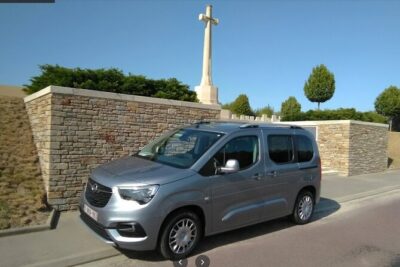
The vehicle has air conditioning and enough room for four adults, according to the information provided. That is useful on a hot day, and it also means less time is lost navigating narrow roads and farm lanes yourself. You should still wear sturdy, comfortable shoes. The tour includes walking at trenches, cemeteries, and outdoor memorials, and Flanders weather can change quickly.
The experience is wheelchair accessible, though you should confirm the practical details of trench access when booking. Original trench ground is not the same as a smooth museum floor.
Caterpillar Mine Crater at Hill 60 B
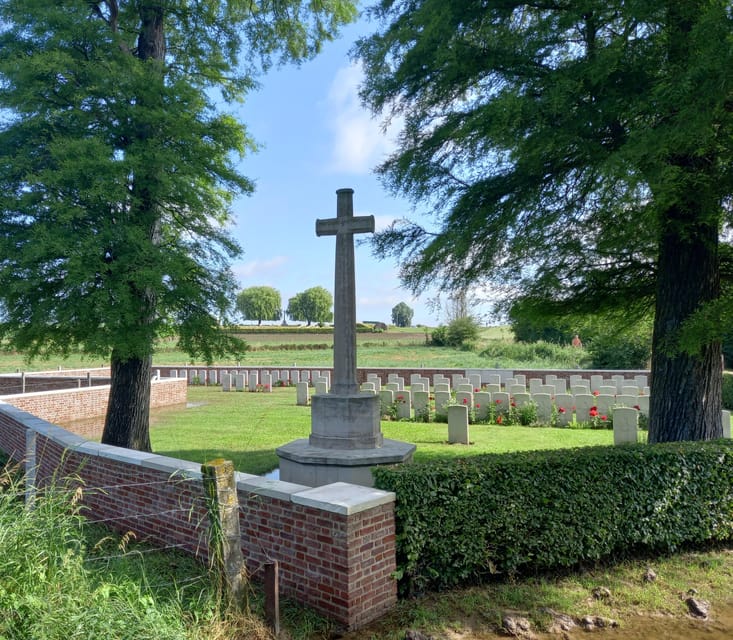
The first major stop is the Caterpillar Mine Crater, part of the Hill 60 area. You get about 30 minutes here, including a guided walk.
This is one of the tour’s most striking physical reminders of the 1917 fighting. The massive crater was created by an underground mine explosion, and its scale helps explain how the war reshaped the ground itself. Maps and explanation from the guide are especially useful here because the meaning of a crater is hard to grasp without knowing which forces were attacking and what the position controlled.
Hill 60 is also a favorite stop for people who want to see something more immediate than a memorial or cemetery. You are not simply looking at names carved in stone. You are seeing a scar left by the battle.
Thirty minutes is enough for an introduction, photographs, and a guided explanation. It may feel short if you want to study every feature or linger in silence. If Hill 60 is your main interest, tell the guide early. The private format gives you the best chance of making sensible adjustments.
Sanctuary Wood and its preserved trenches
Sanctuary Wood Museum receives about 50 minutes. The key attraction is the chance to walk original trenches, which gives this part of the tour a different feel from the formal cemeteries.
The word original matters here. You can move through defensive lines and get a physical sense of how confined and exposed trench life was. The guide supplies the wider story, while the ground itself gives you scale. It is easier to understand why maps, roads, ridges, and small rises mattered so much once you are standing among the remains.
The museum entrance is included. That makes this a useful combination of outdoor site and indoor context within a short tour. I would give this stop your full attention rather than treating it as a quick photo break.
The terrain may be uneven, and comfortable footwear is essential. Bring weather-appropriate clothing and a camera, but do not let photography crowd out the experience. The trenches are one of the places where a few quiet minutes can say more than another block of explanation.
A few more trips and experiences worth a look
- From Brussels: Flanders Fields Remembrance Full-Day Trip
★ 4.4 · 65 reviews - From Ypres, The Christmas Truce to Passchendaele Ypres Based WW1 private tour
★ 5.0 · 29 reviews - In Flanders Fields and Passchendaele Grand Tour
★ 5.0 · 25 reviews - Full Day Canadian WW1 Vimy and Somme Battlefield Tour from Ypres
★ 5.0 · 6 reviews
Tyne Cot Cemetery and the scale of loss
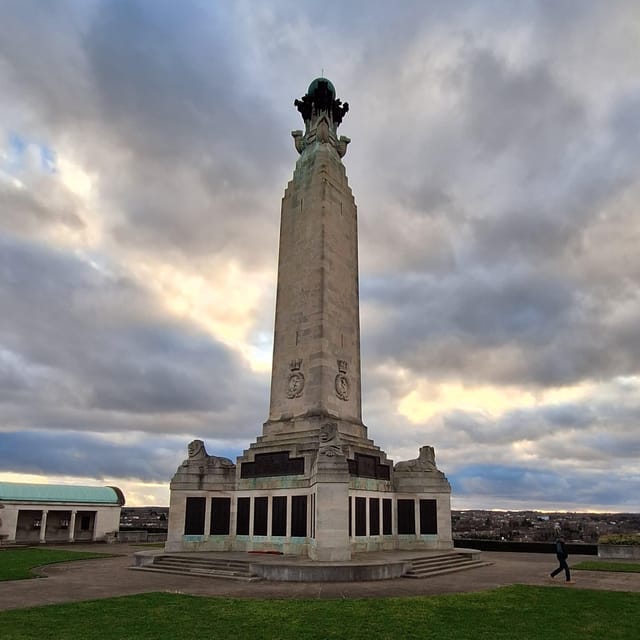
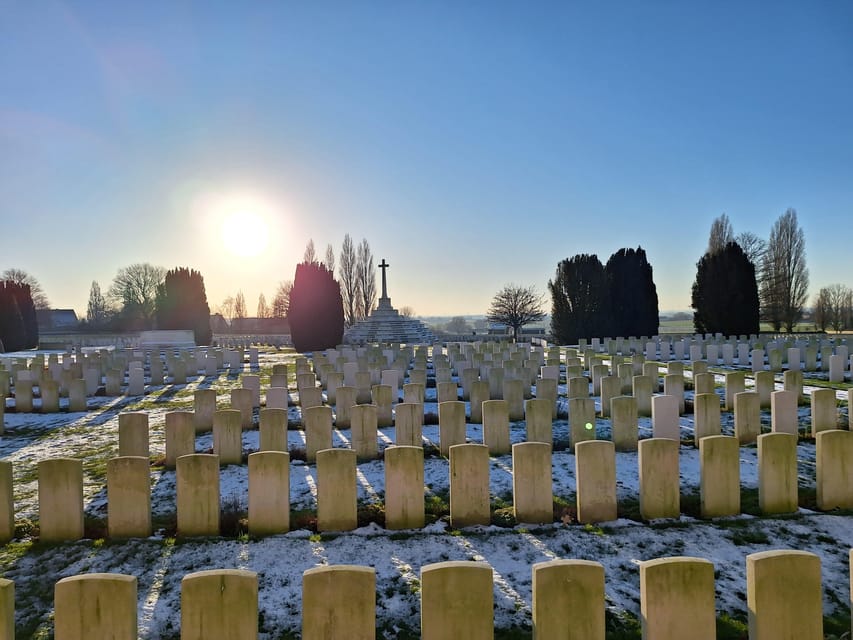
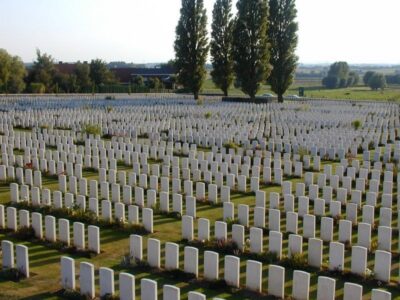
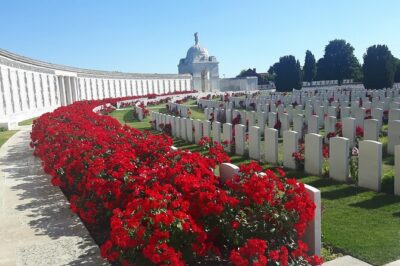
Tyne Cot Cemetery gets about 50 minutes with the guide. It is one of the central stops because it brings the fighting down to individual names while also showing the enormous human cost of the campaign.
Around 12,000 war dead are buried here, making the cemetery difficult to take in all at once. The scale can become numbing, so the guide’s explanation helps you connect this place to the attacks toward Passchendaele and to the Australian, Canadian, New Zealand, South African, and British forces involved.
This is also the stop where family research can become very specific. The guide can help locate a known grave or memorial entry when the information is available. One Canadian visitor received help searching for a Victoria Cross recipient, while another family group visited a grave connected to an ancestor.
Allow yourself some independent time here. The tour is guided, but the best balance is not constant talking. The strongest part of the experience is the combination of battlefield context, names, and a few moments to reflect.
The Brooding Soldier memorial
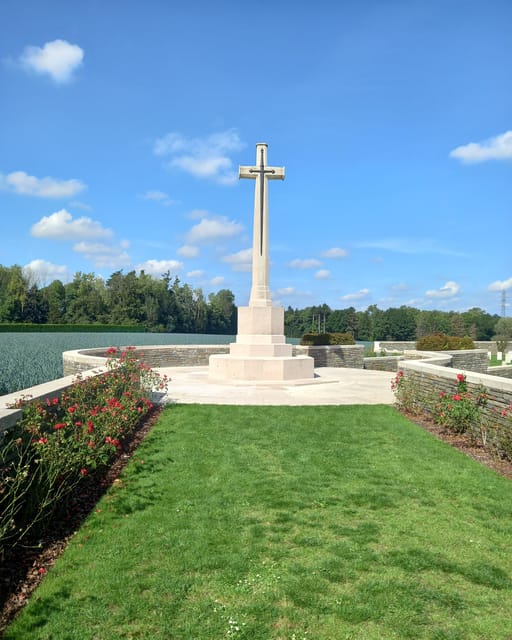
The Brooding Soldier takes about 20 minutes. This memorial marks the Canadian troops affected by the first German gas attack in 1915.
The subject is grim, but the memorial is simple and direct. It gives the tour a chronological layer beyond the 1917 route, showing that the Ypres Salient was not one single battle. The earlier gas attack changed the nature of warfare and left soldiers facing a weapon for which they had little protection.
This stop is particularly useful on the Canadian itinerary, but it adds important context to any route. If your knowledge of the Ypres fighting begins and ends with Passchendaele, this site reminds you that the story reaches back to 1915.
Twenty minutes is a sensible amount of time. You hear the background, see the memorial, and have a moment to take it in without turning the visit into a long lecture.
John McCrae’s dressing station and Essex Farm
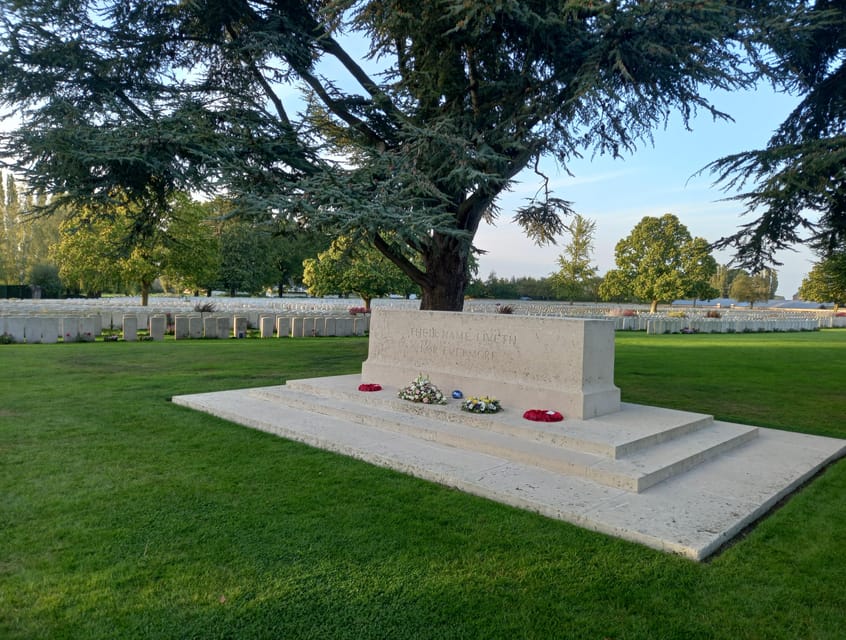
The tour then reaches the dressing station associated with John McCrae, where he wrote In Flanders Fields. You get about 35 minutes for a photo stop.
This is a place where the familiar poem can become more concrete. The connection between a medical dressing station, the wounded, and McCrae’s writing gives the poem a physical setting rather than leaving it as a few famous lines repeated at ceremonies.
The visit is described as a photo stop, so expect less formal guiding here than at the cemeteries or museum. If the poem matters to you, ask the guide to explain the site and its place in the wartime story. The private format makes that kind of question easy.
Essex Farm Cemetery follows, with about 10 minutes of guided time. It is a short stop, but it completes the connection between medical care and burial. The limited time means you should arrive with a clear purpose, especially if you are looking for a particular name.
A guide who adapts the story to you
The most praised part of this experience is the guiding. Søren Hawkes is repeatedly described as friendly, funny, patient, and deeply informed about the local sites. Sabine is also praised for careful preparation and for building a route around New Zealand family connections.
That does not mean the tour is a scripted performance. The guide can use maps, charts, service records, diaries, and local knowledge to explain what happened and where. One guide even showed a wartime munitions dump found in a farmer’s field, a small detail that shows how the past still appears around the modern countryside.
You should send ancestor information before the tour if you have it. Names, units, dates, cemeteries, service records, and diary extracts can help the guide decide what to include. The promise is not that every person can be found, but the guide will try to tailor the route when possible.
The tone also seems well judged. The subject is solemn, but the guides use appropriate humor and do not rush from one site to the next. Several private groups received extra stops when the guide saw that a particular regiment or national connection mattered to them. That flexibility is a major reason to choose this over a standard bus outing.
How much can you really see in four hours?
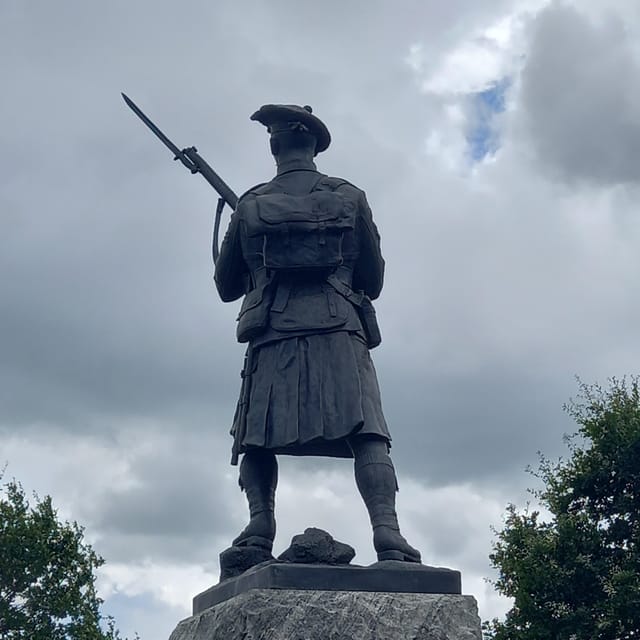
The route covers seven listed stops, including pickup and return to Ypres. That is a lot for four hours, even though several locations are close enough to connect efficiently by car.
You will get an overview of the Ypres Salient, not every battlefield detail. The tour works best when you decide on a priority before setting out. For example:
- Choose the Australian route if your family or interests center on 1917 Australian operations.
- Choose the Canadian route if you want the 1915 gas attack, Canadian memorials, and later Canadian fighting.
- Choose the Kiwi route for New Zealand units and family graves.
- Tell the guide if a specific ancestor, regiment, cemetery, or poem matters most.
The route may go beyond the advertised four hours when the guide adds relevant sites, as happened for some private groups. I would not count on extra time, though. Treat it as a welcome possibility, not part of the guaranteed schedule.
Who will get the most from this tour?
I would recommend it most strongly to people with a family link to the First World War. The guide’s ability to work with ancestor details gives the outing a level of focus that a general sightseeing tour cannot match.
It also suits first-time visitors who want a clear foundation before exploring Ypres further. You see trenches, a mine crater, a major cemetery, a memorial, a dressing station, and a smaller cemetery in one compact route.
Military-history readers will appreciate the national route choices and the use of maps. The tour is also a good fit for mixed groups because the guide can move between Australian, Canadian, New Zealand, British, South African, and American interests.
I would be more cautious if you dislike outdoor walking, solemn cemetery visits, or a fast overview. The experience is wheelchair accessible, but some original trench areas may require advance discussion. Food is not included, and the four-hour format does not appear to include a meal break.
Free cancellation is available up to 24 hours before departure, and you can reserve now and pay later. Starting times depend on availability. Those policies are useful if your Ypres plans are still moving, but the real decision is how much value you place on private guiding.
Should you book this Ypres battlefield tour?
Book it if you want personal attention, have an ancestor to trace, or prefer a guide who can explain why each site matters instead of simply naming it. The private price is fair for four people, especially when you count transport, museum entry, pickup, and the ability to shape the route.
For solo visitors or couples, the cost is harder to justify unless family research is central to the trip. A longer tour might also suit you better if you want extended time at every cemetery.
For most first visits to the Ypres battlefields, though, this is a strong choice. Ask for the Australian, Canadian, or Kiwi route that matches your interests, send family details ahead of time, and wear shoes made for uneven ground. You will come away with more than a list of famous sites. You will understand how the places connect, and why the names still matter.
FAQ
How long is the Ypres WWI battlefield tour?
The tour lasts four hours, with pickup and return in Ypres. Some private tours have gone beyond four hours when additional relevant sites were added.
What is included in the price?
The price includes a private four-hour tour, hotel pickup and drop-off, an English-speaking guide, mineral water, and the museum entrance fee.
How many people can join the private tour?
The listed price of $530 covers a private group of up to four people.
Can the tour include an ancestor’s grave or battle site?
Yes. If you provide information about a family member who served or died in the battle, the guide can tailor the tour to include that person when possible.
Which national battlefield routes are available?
There are three route options: Australian 1917 Ypres battlefields, Canadian 1915 and 1916/1917 Ypres battlefields, and Kiwi 1917 Ypres battlefields.
What should I bring?
Bring comfortable shoes, a camera, and clothing suited to the weather. Food is not included.
Just added around Ypres
- PRIVATE Australian Western Front Battlefields 3-Day Tour Ypres to Amiens★ 5.0 · 3 reviews
- Discover Tournai while playing! Escape game – The alchemist★ 4.0 · 3 reviews
- From LIlle or Bruges, Christmas Truce to Passchendaele Ypres 1 day WW1 private★ 5.0 · 5 reviews
- From Ypres 4hr Christmas Truce and Monster Mines of Messines PRIVATE Tour★ 5.0 · 5 reviews
- Full Day Canadian WW1 Vimy and Somme Battlefield Tour from Ypres★ 5.0 · 6 reviews
- e-Scavenger hunt Ypres: Explore the city at your own pace★ 4.5 · 6 reviews
- In Flanders Fields and Passchendaele Grand Tour★ 5.0 · 25 reviews
- From Ypres, The Christmas Truce to Passchendaele Ypres Based WW1 private tour★ 5.0 · 29 reviews
Flanders Fields & WWI Tours, compared.
Great War Flanders Fields Minibus Tour w/ Lunch
Read our review →
Flanders Fields Remembrance Tour from Brussels
Read our review →
In Flanders Fields and Passchendaele Half Day Morning Tour
Read our review →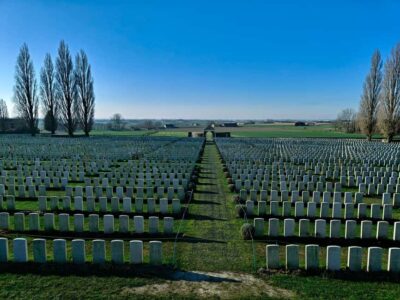
An exploration of the deadly salient battlefields
Read our review →
Browse the lists this tour appears in